Lite Studio Webclip

Simplify Your Website. Elevate Your Brand.

Schedule a call with our expert web design and answer engine optimization team today to discuss how we can improve search visibility and upscale your brand's online presence in just 30 days.

Schedule Call

Voice Search vs Traditional SEO: What's Different?

Justin Lundstrom Lite Studio Project Manager Headshot
Justin Lundstrom
November 29, 2025
Explore the differences between voice search and traditional SEO, and learn how to optimize for each to meet evolving user needs.

Article Summary

What's the main difference between voice search and traditional SEO?

Voice search uses natural, conversational queries for immediate answers, while traditional SEO focuses on short keywords and research-driven results.

How do people use voice search differently than typing?

Voice search is used during multitasking with full sentences and question words, demanding instant, actionable answers; traditional search is more deliberate and exploratory.

What keyword strategy works best for voice search optimization?

Use conversational, long-tail, question-based phrases with local modifiers to match natural speech and immediate needs.

What technical requirements are essential for voice search success?

Prioritize site speed (<3 seconds), featured snippets, structured data/schema markup, mobile performance, and Core Web Vitals.

Why is local SEO more important for voice search?

"Near me" and real-time queries dominate voice search, requiring precise, location-based answers and up-to-date business info.

Voice search is changing how people look for information online. Instead of typing short phrases like "pizza near me", users now ask conversational questions like, "Where's the best pizza place nearby?" This shift impacts how businesses optimize their content for search engines.

Here’s what you need to know:

  • Voice Search: Relies on natural, conversational queries, often longer and more specific. Users expect quick answers, especially for local and time-sensitive needs.
  • Traditional SEO: Focuses on short, keyword-driven searches. Users are more likely to explore multiple results and compare options.

Key Differences:

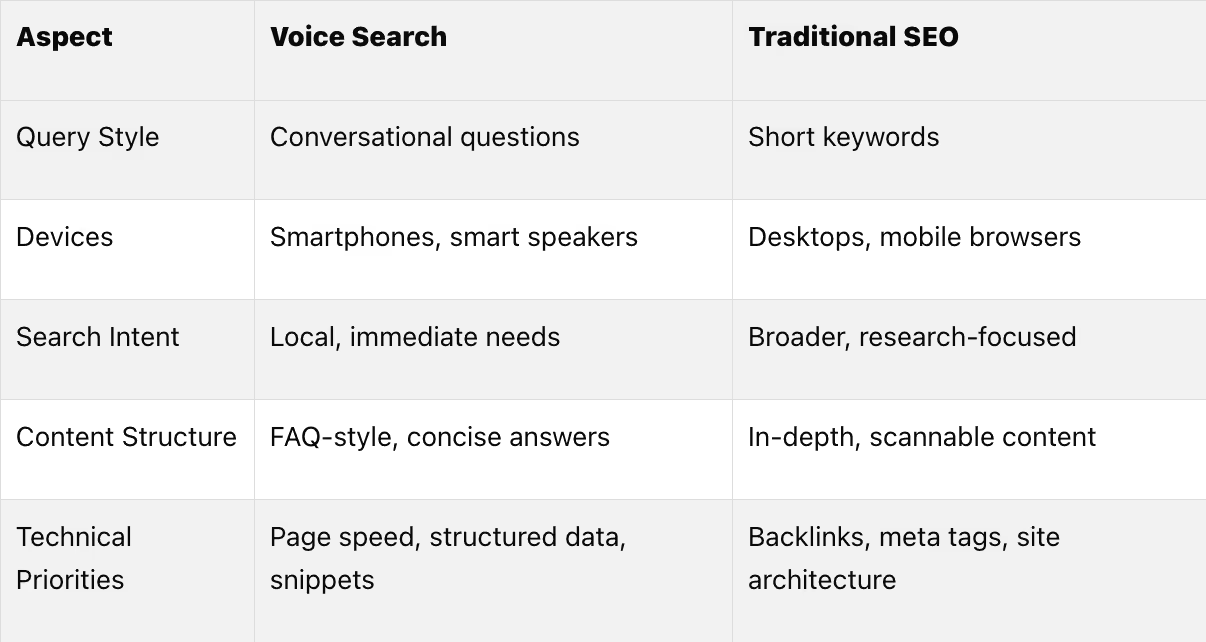
  1. Query Style: Voice search uses full sentences; traditional search relies on short phrases.
  2. Devices: Voice search happens on smartphones, smart speakers; traditional search is common on desktops and mobile browsers.
  3. Intent: Voice users often need immediate, local answers, while traditional search supports broader research.

Quick Comparison:

Table comparing various aspects of Voice Search and Traditional SEO.

To succeed, businesses need to optimize for both approaches. Voice search prioritizes fast, conversational, and local content, while traditional SEO focuses on detailed, keyword-rich strategies. Combining both ensures you meet user needs across all search methods.

How Optimizing for Voice Search Improves Your Website’s SEO

User Behavior and Search Intent: Voice vs Traditional SEO

Voice search has reshaped how people interact with search engines, presenting businesses with a unique challenge: understanding and optimizing for the distinct behaviors of voice and traditional search users.

How People Use Voice Search

Voice search thrives on natural, conversational language. Instead of typing something like "weather Chicago", users ask, "What's the weather like in Chicago today?" This shift toward full sentences and questions reflects how people naturally speak.

Multitasking is a major driver for voice search. People turn to voice commands when their hands are busy - whether they're cooking, driving, working out, or otherwise occupied. The hands-free convenience makes voice search the go-to option in situations where typing isn’t practical or safe.

Voice queries tend to be more specific and action-oriented. Users often include words like "how", "what", "where", "when", and "why", signaling their need for immediate, actionable answers. For example, instead of typing "pizza near me", a voice query might be, "What's the best pizza place near downtown that's open right now?" These queries are rich in context, reflecting a conversational tone that demands precise responses.

Next, let’s see how this conversational style contrasts with the more keyword-driven approach of traditional search.

How Traditional Search Works

Traditional search focuses on users who type their queries, often relying on shorter, keyword-focused phrases. These users usually start with broad searches and refine their queries based on the results they see. It’s a more exploratory process, where users are willing to sift through multiple pages to find what they need.

Typed queries favor concise, targeted keywords. People strip away unnecessary words, focusing on the essentials. For instance, instead of asking, "Where can I find the best Italian restaurant in my area?" they might type "best Italian restaurant near me" or just "Italian restaurant."

Desktop and mobile browser users tend to have more patience compared to voice search users. They’re more likely to scroll through results, read snippets, and compare options before making a decision. This gives businesses a chance to grab attention through well-crafted meta descriptions, compelling titles, and structured snippets.

Traditional search often involves research and deliberation. Users compare prices, read reviews, and even bookmark pages for later. This creates a longer decision-making process, where businesses must provide detailed, trustworthy content to win over potential customers.

While traditional search leans toward a research-driven approach, voice search is all about immediacy and location-based needs.

Local and Immediate Needs in Voice Search

Voice search is heavily geared toward instant, actionable results. When someone asks, "What's the nearest gas station?" or "Is Target open right now?" they expect precise, real-time answers they can act on immediately. This urgency sets voice search apart from traditional SEO, which often caters to users planning for the future.

"Near me" searches dominate voice queries. These are especially common among mobile users looking for nearby restaurants, stores, or services. The expectation is that the search engine will automatically factor in their current location, saving them the trouble of specifying it.

Time-sensitive queries are another hallmark of voice search. Questions like "What's traffic like on I-95 right now?" or "Which grocery stores are open late tonight?" highlight the need for up-to-the-minute information. Voice search users typically receive one primary answer, creating a high-stakes environment where businesses must aim for featured snippets or position zero to capture this traffic.

The differences in user behavior between voice and traditional search demand distinct optimization strategies. Voice search prioritizes conversational content, local relevance, and immediate value, while traditional SEO can focus on broader keywords and detailed content that supports users throughout their research journey.

Keyword Strategies and Content Optimization

As user behavior shifts between voice and traditional search, keyword strategies need to reflect this change by incorporating conversational language. Unlike the short, direct keywords of traditional SEO, voice search optimization relies on natural, question-based phrases that mimic everyday speech.

From Short Keywords to Conversational Phrases

Traditional SEO has typically focused on concise terms like "Italian food" or "pizza delivery." In contrast, voice search expands these into full, conversational questions such as, "Where can I find good Italian food near me?" or "What's the best Italian restaurant delivering tonight?"

Voice search is dominated by question-based keywords. For example, a plumbing business that once targeted "emergency plumber" might now need to optimize for phrases like, "Who can fix my broken pipe right now?" or "How do I find a plumber available on weekends?"

Long-tail keywords also take center stage in voice search. Queries that might have been as brief as "coffee shop" now transform into more detailed phrases like, "What coffee shops are open late near downtown?" or "Which coffee shop has the best Wi-Fi for working?" These phrases not only reflect natural language but also signal a higher intent to act.

Additionally, voice search often includes local modifiers to meet the immediacy of user needs. For instance, instead of just "dentist", users might ask, "Find me a dentist within 10 minutes of my house", or "What's the closest dentist that takes my insurance?"

This evolution in keyword strategy underscores the need for content tailored specifically to voice search.

Writing Content for Voice Search

Once your keyword strategy is in place, the next step is adjusting your content to align with voice search needs. Voice-optimized content thrives on a conversational tone and provides direct answers to user queries. Unlike traditional SEO content, which may lean on formality or keyword density, voice search content should be approachable and straight to the point.

FAQ-style content is particularly effective for voice search. Clear headings like "How Much Does Window Installation Cost?" or "What Should I Expect During Window Installation?" help search engines connect your content with voice queries. Answers should be concise - ideally between 20–40 words - and actionable, avoiding lengthy paragraphs.

Local businesses can also benefit by incorporating conversational location references. For example, instead of simply stating, "serving the Chicago area", you could say, "We help homeowners throughout Chicago, including neighborhoods like Lincoln Park, Wicker Park, and the Loop, with same-day window repairs."

Tools for Finding Voice-Friendly Keywords

To identify conversational, question-based keywords, certain tools can be especially helpful:

  • AnswerThePublic: This tool organizes questions people frequently ask about a topic, sorted by question types like "what", "how", "where", and "why." For example, a fitness business might discover queries such as, "What exercises burn the most calories?" or "How often should I work out to lose weight?" These insights are invaluable for planning voice search strategies.
  • Google's 'People Also Ask' Feature: When you search for a topic, this feature displays related questions that often mirror voice search patterns. For example, searching "home security systems" might reveal questions like, "What's the best home security system for beginners?" or "How much do home security systems cost per month?" These can guide your content creation efforts.
  • Google Keyword Planner: While still useful, this tool should now be used to identify longer, conversational phrases with modifiers like "near me" or "open now." Instead of focusing solely on high search volumes, prioritize keywords that reflect user intent, as these often lead to higher conversion rates.

Finally, testing voice queries directly can uncover ranking opportunities and help refine your content strategy for voice search success.

Technical Optimization: Voice Search vs Traditional SEO

The technical backbone of your website plays a critical role in both traditional and voice search optimization, though the priorities for each differ. Knowing these distinctions allows you to allocate resources wisely and fine-tune your site for both search methods.

Technical Priorities for Traditional SEO

Traditional SEO relies on a well-defined set of technical factors that search engines evaluate to rank websites. Start with optimizing on-page elements like title tags, meta descriptions, header structures, and internal linking. These components help search engines grasp the context and relevance of your content.

Another cornerstone is your backlink profile. Links from credible, high-authority domains signal expertise and trustworthiness to search engines, which can significantly boost rankings. Additionally, with Google’s focus on mobile-first indexing, ensuring your site performs well on mobile devices is now a must.

Your site’s architecture and crawlability are also crucial. Search engines need to easily navigate and index your content. Tools like XML sitemaps, robots.txt files, and clean URL structures help create a solid technical foundation.

Keyword optimization remains a key focus for traditional SEO, especially within technical elements. This includes weaving target keywords into title tags, meta descriptions, and header tags while maintaining a natural keyword density throughout your content.

Technical Requirements for Voice Search

Voice search optimization, on the other hand, requires a slightly different approach. Site speed becomes a top priority since voice search users expect quick answers. Pages that load in under 3 seconds have a much better chance of being featured in voice search results.

Aiming for featured snippets is essential for voice search success. Voice assistants often pull responses directly from these snippets. To increase your chances, structure your content to provide clear, concise answers to specific questions.

Incorporating structured data and schema markup is another key tactic. These tools provide search engines with additional context, improving your chances of appearing in voice search results. For local businesses, schema markup for details like addresses, phone numbers, and business hours can significantly enhance visibility.

Local SEO plays an even bigger role in voice search, as many queries are location-based. To optimize, focus on your Google Business Profile, ensure consistent NAP (Name, Address, Phone) information across all directories, and use location-specific schema markup.

These voice search strategies align closely with broader mobile performance goals, which are discussed below.

Core Web Vitals and Mobile Performance

Google’s Core Web Vitals are crucial for both traditional and voice search, but they hold particular importance for voice search optimization. For example:

  • Largest Contentful Paint (LCP) measures how fast your main content loads. Aim for under 2.5 seconds to stay competitive in voice search.
  • First Input Delay (FID) tracks how quickly users can interact with your page. For mobile voice search, where users may need to tap links or buttons after hearing results, FID should be under 100 milliseconds.
  • Cumulative Layout Shift (CLS) ensures page elements don’t shift unexpectedly during loading, which is vital for mobile users navigating your site after a voice search.

Since most voice searches happen on mobile devices, mobile-first design is non-negotiable. This includes responsive layouts, touch-friendly interfaces, and content optimized for smaller screens. Beyond Core Web Vitals, mobile usability involves ensuring text is readable without zooming, clickable elements are well-spaced, and horizontal scrolling is avoided. Mobile users expect smooth, intuitive navigation.

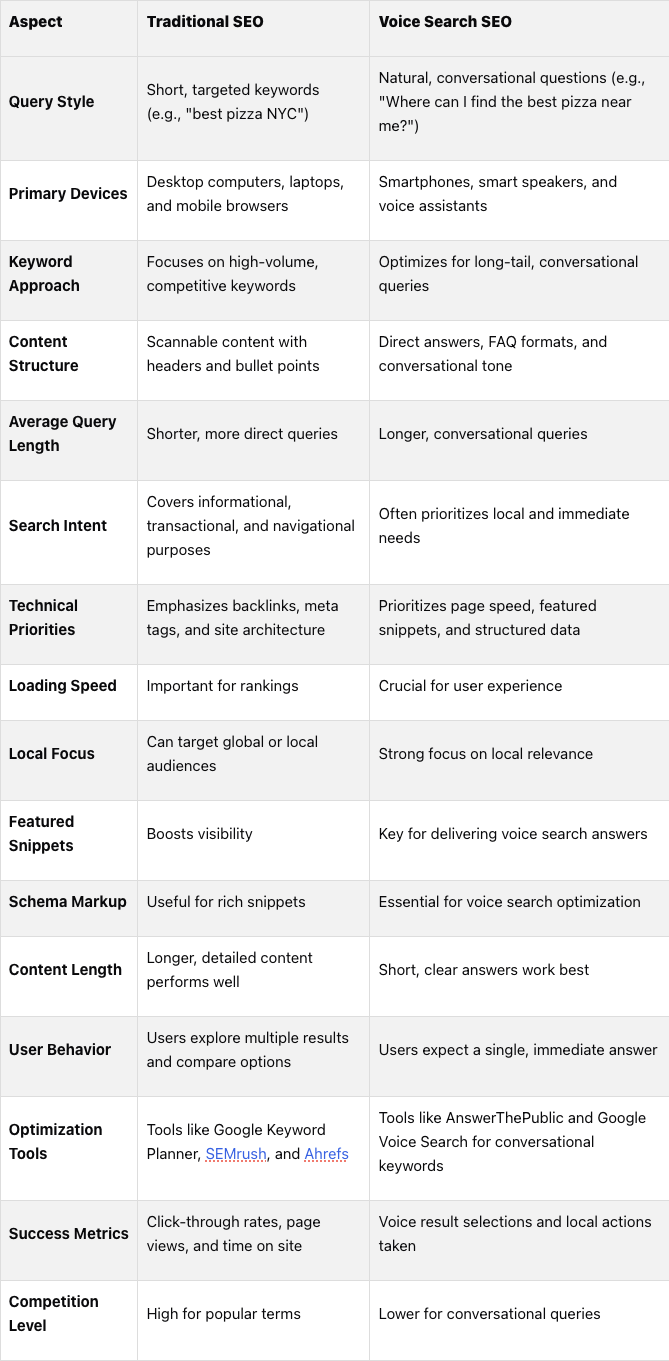
Traditional SEO vs Voice Search Comparison Table

3 column table providing a detailed comparison of Traditional SEO and Voice search.

Lite Studio's Approach to Voice Search Optimization

Lite Studio has fine-tuned its strategies to meet the unique demands of voice search optimization. By combining advanced techniques like Answer Engine Optimization (AEO) and GEO-specific strategies, they prepare websites to excel in AI-driven search environments.

Data-Driven Voice Search Solutions

Lite Studio kicks off its process with in-depth UX research, analyzing how users interact with voice search. This data-first method blends user behavior insights with technical fine-tuning to create websites that rank well in voice search results.

A standout feature of their approach is their implementation of structured data. They craft detailed, context-rich information - like local details, product specifics, and concise FAQs - ensuring voice assistants can easily interpret and deliver accurate answers. Additionally, they prioritize fast-loading, mobile-optimized pages, meeting the needs of voice search users who expect quick, precise responses. For more complex websites, Lite Studio simplifies the architecture to improve performance in both voice and AI search.

Simplifying Complex Websites for Voice and AI Search

Large websites with dense content often struggle with voice search. Lite Studio transforms these into streamlined platforms optimized for conversational queries.

They reorganize site content to highlight the most relevant information for voice users, simplifying navigation and content layouts. This makes it easier for voice assistants to find and deliver key answers. They also optimize content to match natural language patterns, rewriting existing material and developing FAQ sections that address common voice queries while sounding natural when spoken aloud.

Service Offerings

Lite Studio provides tailored services to help businesses thrive in voice and AI-driven search landscapes:

  • Answer Engine Optimization (AEO): Starting at $2,000, this service enhances visibility in voice and AI search through advanced AEO techniques.
  • Website Development: Priced from $2,000, Lite Studio delivers customized Webflow and Framer-built sites that are fast, mobile-friendly, and meet technical standards for voice search.
  • User Experience Research: Starting at $3,000, this service offers detailed insights into how audiences use voice search, informing content strategies and optimizing for conversational queries.

Lite Studio's methods empower businesses to stay ahead of evolving search trends, helping them capture the attention of voice search users who demand quick and accurate answers.

Conclusion: Getting Ready for the Future of Search

Search is evolving fast, and businesses that adapt to both voice and traditional SEO are better positioned to stand out. While traditional SEO continues to be the backbone of online visibility, voice search optimization is becoming increasingly important for reaching users who rely on voice assistants for quick, conversational responses.

Main Takeaways

Here’s a quick recap of the key differences between voice search and traditional SEO: user intent and behavior. Traditional search users often type short, direct keywords and are prepared to sift through several results. In contrast, voice search users phrase their queries conversationally, often expecting immediate, specific answers.

When it comes to keyword targeting, this shift is significant. Instead of focusing on short keywords like "best pizza NYC", businesses need to think in terms of natural, conversational queries like "Where’s the best pizza near me tonight?" This shift impacts everything from content strategy to the technical setup of your site.

On the technical side, voice search has unique demands. It requires ultra-fast load times, mobile-friendly design, and structured data that voice assistants can easily interpret. For local businesses, this is especially important since many voice searches are tied to location-based needs.

The best strategy? Combine both approaches. Traditional SEO ensures broad visibility, while voice search optimization helps you capture users in those critical, immediate moments when they need answers fast.

Why Continuous Updates Matter

Search technology is advancing at breakneck speed. AI-powered search engines and voice assistants are getting smarter every month, and user habits are shifting as people become more comfortable using voice search for things like local recommendations, quick facts, or hands-free tasks (think cooking or driving).

Google is increasingly favoring content that caters to both traditional and voice search users. Staying flexible with your SEO strategy is key as voice recognition improves and user expectations evolve.

To stay ahead, businesses need to treat SEO as an ongoing effort, not a one-and-done task. Regularly auditing your content, monitoring performance, and updating strategies will keep your site visible across all search formats. As voice search continues to gain traction in the U.S., early adopters will gain a competitive advantage, leaving others scrambling to catch up.

The takeaway? Success in the future of search means embracing both traditional and voice search optimization today. Businesses that can deliver fast, accurate answers will own the search landscape of tomorrow.

FAQs

What are the best ways for businesses to optimize their content for both voice search and traditional SEO?

To get the most out of both voice search and traditional SEO, businesses should target conversational, long-tail keywords - the kind of phrases people naturally use when speaking. It’s equally important to create content that directly addresses common questions in a way that’s clear and easy to understand.

Adding schema markup can make a big difference too. This helps search engines better interpret your content, which can boost your visibility in voice search results. Don’t overlook local SEO strategies either, as many voice searches are tied to local queries. Make sure your site is mobile-friendly, loads quickly, and includes up-to-date local business details like your address and phone number.

By blending these approaches, businesses can keep pace with the rise of voice search while continuing to perform well in traditional search rankings.

What technical steps should businesses take to optimize for voice search compared to traditional SEO?

To get the most out of voice search, businesses need to focus on a few technical essentials. Start with fast loading speeds - aim for under 1.5 seconds. Combine that with a mobile-first design and secure your site with HTTPS protocols to keep it running smoothly and ranking well in voice search results. On top of that, implementing structured data (schema markup) can help search engines better interpret and display your content.

Voice search often ties closely to location-based queries, so local optimization is another priority. Make sure your business details - like name, address, and phone number (NAP) - are accurate and consistent across all platforms. Finally, adjust your keyword strategy to focus on conversational phrases and questions, which reflect the way people naturally speak when using voice search.

Why should businesses prioritize local relevance and quick responses in voice search optimization?

Businesses should prioritize local relevance and immediacy when it comes to voice search. Why? Because many voice queries are tied to location and urgency. For instance, a significant number of voice searches include phrases like "near me", as people rely on voice assistants to quickly locate nearby businesses or services.

Focusing on local relevance helps businesses appear in geographically targeted search results, which can lead to more foot traffic and stronger local connections. At the same time, addressing immediacy ensures your business provides quick and accurate answers - something voice assistants heavily factor in when delivering results. Combining these two strategies can boost your visibility and help you attract potential customers right when they need you most.

Key Points

How does user behavior differ between voice search and traditional SEO, and what does this mean for content strategy?

  • Voice: Conversational, multitasking, expects instant answers.
  • Traditional: Research-driven, patient, compares options.
  • Strategy: Use FAQ-style, concise answers for voice; comprehensive, detailed content for traditional.

What are the most effective keyword strategies for optimizing content for voice search in 2025?

  • Long-tail, conversational, question-based keywords.
  • Local intent modifiers.
  • Tools: AnswerThePublic, Google "People Also Ask", Keyword Planner.

What technical optimizations are critical for voice search success compared to traditional SEO?

  • Speed: <3s load time.
  • Schema markup: Local business, FAQ, product.
  • Featured snippets: Clear, concise answers.
  • Mobile-first: Responsive, touch-friendly, optimized for Core Web Vitals.

Why is local SEO optimization more crucial for voice search, and how should businesses adapt?

  • Immediate, location-based intent.
  • "Near me" dominance.
  • Single-answer expectation.
  • Actions: Optimize Google Business Profile, consistent NAP, location schema, real-time info.

How should businesses create and structure content to maximize visibility in both voice search and traditional SEO?

  • Conversational, answer-first, FAQ format.
  • Dual-purpose: Comprehensive for traditional, concise for voice.
  • Local context and content length balance.

What does the future of search optimization look like, and how should businesses prepare?

  • AI-driven, context-aware search.
  • Integrated optimization (voice + traditional).
  • Continuous adaptation and regular audits.
  • Early adopters gain competitive advantage.

Get Started

Streamline your online presence and captivate users with a refined, single or minimal page experience. Schedule a call with our team today to discuss how we can simplify your site and elevate your brand in just 30 days.

Schedule Call