Lite Studio Webclip

Simplify Your Website. Elevate Your Brand.

Schedule a call with our expert web design and answer engine optimization team today to discuss how we can improve search visibility and upscale your brand's online presence in just 30 days.

Schedule Call

User Intent in Conversational Search

Calix Xavier
June 16, 2026
Conversational queries average 25 words. AI-referred traffic converts at 14.2 percent. Intent-mapped content earns 2.6 times more citations than keyword-optimized content. The mechanics of user intent in conversational search — and how to map it — are now the most consequential variables in enterprise content strategy.

Article Summary

How has conversational search changed the way user intent is expressed and interpreted?

Conversational search queries now average 18 to 25 words — compared to the 6-word average of traditional keyword searches — providing AI systems with significantly more context for intent interpretation. Navigational intent has declined from 32.2 percent in traditional search to just 2.1 percent in AI chat models. A new intent category — generative intent, covering requests for AI to create, draft, or complete tasks — now represents 37.5 percent of AI chat interactions. AI-generated answers appear in over 30 percent of Google searches, up from 6.5 percent in early 2025, making conversational intent mapping a core rather than supplementary element of enterprise content strategy.

What are the core types of user intent in conversational search and how do they differ from traditional search intent?

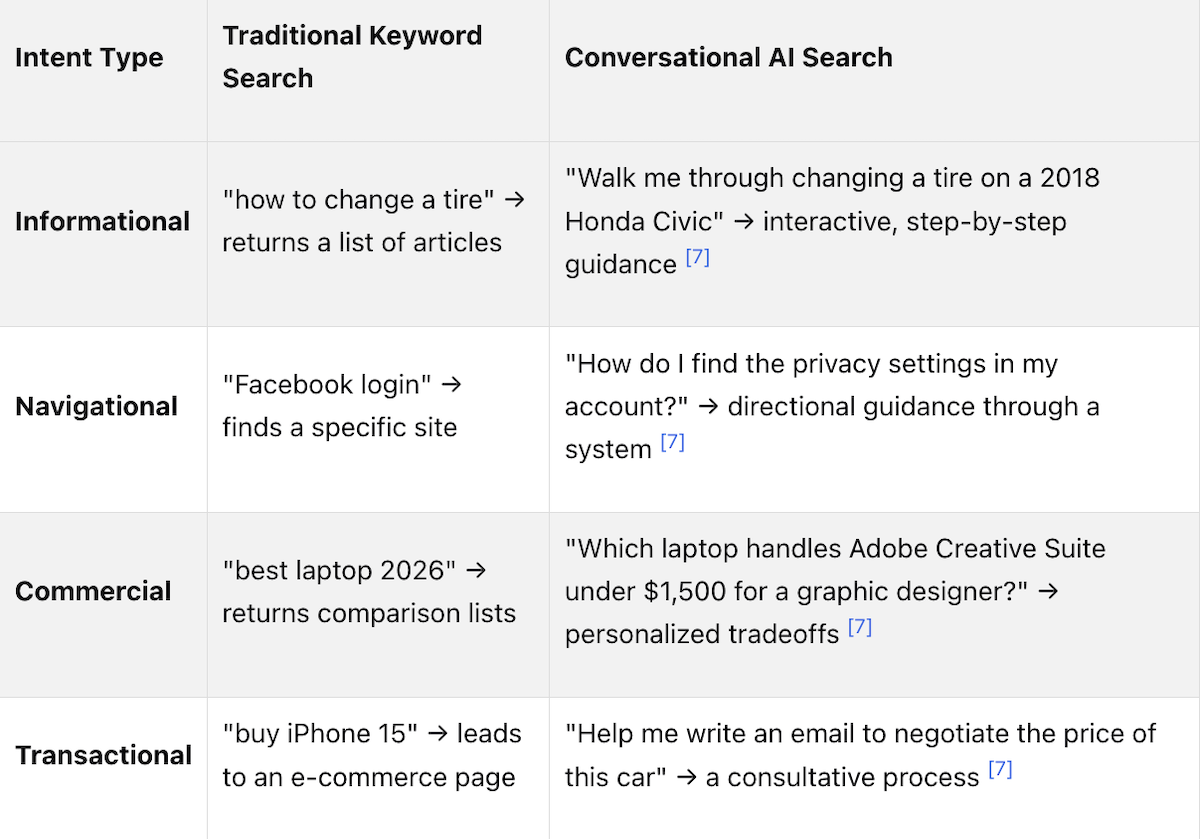
The four traditional intent types — informational, navigational, commercial investigation, and transactional — remain relevant in conversational search but behave differently. Informational queries shift from returning article lists to providing interactive step-by-step guidance. Commercial queries shift from returning comparison lists to delivering personalized tradeoffs based on specific constraints. Transactional queries shift from linking to e-commerce pages to facilitating consultative processes. A fifth category — generative intent — has emerged specifically in AI contexts, encompassing requests for content creation, drafting, and task completion that have no equivalent in traditional search behavior.

What is hybrid intent and why does it matter for content strategy?

Hybrid intent describes conversational queries that blend multiple intent types simultaneously — for example, a query that combines comparative research, synthesis, and exploratory intent in a single prompt. Because the average AI search session includes 3.4 queries with each turn building on the previous one, intent frequently shifts within a single conversation — beginning with informational questions, transitioning to commercial comparison, and ending with transactional requests. Content that anticipates these shifts by structuring pages to address follow-up questions and linking related content remains relevant throughout the full user journey rather than serving a single intent moment.

How do AI search engines technically interpret conversational intent and what makes their approach different from traditional keyword matching?

AI search engines interpret conversational queries through tokenization into subwords, transformation into embeddings that group related meanings in semantic space, and attention mechanisms that analyze relationships between all tokens simultaneously. Rather than classifying queries into fixed intent categories, modern AI systems model intent as a probability distribution across a continuous semantic space — producing nuanced understanding that rigid category labels cannot capture. Semantic component analysis breaks complex queries into parts that each trigger their own retrieval process. Retrieval-Augmented Generation systems like Perplexity and Google AI Overviews retrieve specific 200 to 500 token passages matched by cosine similarity rather than pulling entire web pages.

What performance metrics distinguish brands that have adapted to conversational search intent from those that have not?

AI search visitors convert at 14.2 percent compared to 2.8 percent for traditional search visitors — a five-times higher conversion rate that reflects the pre-qualification that conversational AI performs before sending traffic. AI-referred traffic delivers 67 percent higher customer lifetime value. Intent-mapped content earns 2.6 times more citations in AI-generated answers than content optimized solely for traditional keywords. With zero-click rates on traditional search engines surpassing 65 percent as of early 2026, AI citation — where a brand's content is used as a source rather than merely mentioned — has become a primary visibility metric distinct from rankings and clicks.

Search is changing. Instead of short keywords, people now ask detailed, conversational questions like, "What's the best CRM for a small business with a $500 budget?" This shift is reshaping how AI-powered tools like ChatGPT and Google handle queries.

Key Takeaways:

  • Conversational queries average 25 words, far longer than traditional searches (6 words).
  • AI-generated answers now appear in over 30% of Google searches, up from 6.5% in early 2025.
  • Users expect deeper understanding: AI must interpret, compare, and synthesize information - not just retrieve it.

For businesses, this means mapping user intent is essential. Queries often blend multiple goals (e.g., learning, comparing, buying). Content that directly addresses these intents gets 2.6x more citations and drives 14.2% conversion rates - far higher than older search strategies.

Ready to align your content with this new search behavior? Let’s dive in.

Traditional Search vs. Conversational AI Search: Key Differences & Stats

User Intent and Content Mapping With Garrett Sussman and Alexandra Pielusko

Core Types of User Intent in Conversational Search

Understanding user intent is the foundation of effective conversational search. While the four classic intent types remain relevant, their behavior shifts significantly in conversational contexts. Let’s break these down and see how conversational queries reveal specific intentions.

The 4 Main Types of User Intent

The core intent types - informational, navigational, commercial investigation, and transactional - still apply, but conversational AI introduces new dynamics to how these intents are expressed and addressed.

One major shift is the steep decline in navigational intent within AI-driven search. This type of query dropped from 32.2% in traditional searches to just 2.1% in tools like ChatGPT [8]. Meanwhile, a new category - generative intent - has emerged. This includes requests for AI to create, draft, or complete tasks, and it now represents 37.5% of interactions in AI chat models [8].

How Conversational Queries Signal Intent

Unlike traditional short keywords, conversational queries are much longer and more detailed, averaging 18–25 words [6]. This added context makes it easier to identify user intent. For instance, a query like "What's the average ROI for email marketing campaigns in 2026?" clearly signals informational intent, whereas a shorter query like "email marketing ROI" could be interpreted in multiple ways [4].

"People don't search the same way on AI engines. They explore, refine, and iterate instead of hunting for the perfect keyword." - Jeff Lenney, SEO Expert [6]

This level of clarity allows conversational AI to better understand and respond to user needs, setting the stage for more dynamic interactions.

Multi-Intent and Shifting Intent in Conversations

Conversational queries don’t just provide clarity - they also allow for blended and evolving intent. For example, a query like "Compare real estate CRMs for a small agent team - help me weigh ease of use vs. power, and tell me if I should hire a consultant" combines comparative research, synthesis, and exploratory intent [6]. This is referred to as hybrid intent, and it’s increasingly common.

Intent often shifts as conversations progress. The average AI search session includes 3.4 queries, with each turn building on the previous one [3]. A user might begin with an informational question, transition into commercial comparison, and end with a transactional request - all within the same session. AI systems manage this complexity through semantic component analysis, which breaks down prompts into smaller parts to generate accurate responses [3].

For content creators, this means structuring pages to address follow-up questions and linking related content is crucial. Anticipating these shifts keeps your content relevant throughout the user’s entire search journey [3].

How AI Search Engines Interpret User Intent

How NLP and Context Shape AI Search

When you type a conversational query into an AI search engine, it does more than just look for matching keywords. Instead, it builds a layered understanding of what you're asking. The process starts with tokenization, breaking the query into smaller units called subwords. These subwords are then transformed into embeddings - mathematical representations that group related meanings together in a semantic space [9].

A key part of this is attention mechanisms, which analyze the relationships between all tokens in your query at once. This allows the engine to differentiate between phrases like "free trial" and "free speech" without needing additional clarification [9]. Modern AI search engines also use intent inference, which doesn’t place your query into rigid categories like "informational" or "transactional." Instead, they interpret your goal as a probability distribution across a continuous semantic space, creating a more nuanced understanding of your intent [9].

"When LLMs interpret search intent, they do not classify a query into a fixed category. They model intent as a probability distribution across a continuous semantic space." - Tanishka Vats, Lead Content Writer, HM Digital Solutions [9]

Methods for Detecting and Classifying Intent

Once the AI builds a linguistic foundation, it uses advanced techniques to zero in on your intent. One such method is semantic component analysis. For example, a query like "best CRM for a small business with a limited budget" is broken into parts - "CRM", "small business context", and "budget constraints." Each part triggers its own retrieval process [3].

Another technique is query fan-out, where the engine generates sub-queries (like definitions, comparisons, or use cases) to explore every angle of your original prompt [5]. Additionally, entity salience scores - ranging from 0 to 1 - help the engine determine how central a specific entity is within a document. This ensures the content directly addresses your primary focus [9]. Research consistently shows that content aligned with user intent performs better than content that merely targets keywords [3].

These methods work together to refine how AI engines interpret and respond to your queries.

Tailoring Responses to User Context

AI search engines go a step further by personalizing responses based on context. They don’t treat each query as a standalone request. For example, if you follow up a query with "What about pricing?", the system understands it in relation to the product or service you were just asking about [3]. Other factors, like the type of device you're using or how you're inputting your query, also help shape the response [2].

This personalized approach is enhanced by Retrieval-Augmented Generation (RAG) systems, used by tools like Perplexity and Google AI Overviews. Instead of pulling entire web pages, these systems retrieve specific passages - 200 to 500 tokens long - that closely match your query's context. Using cosine similarity, the engine compares your query's meaning to these passages, ensuring the response fits the nuances of the conversation [9][5].

How to Map User Intent for Conversational Search

How to Build an Intent Map

Start by gathering data from sources like sales calls, support tickets, and live chat transcripts. Tools such as Gong or Chorus.ai can help pinpoint the exact language customers use when describing their problems or asking questions [10]. Unlike traditional search queries, conversational queries tend to be longer and more nuanced, making them far more insightful for understanding customer needs than a simple keyword list.

Once you've collected a solid set of queries, group them by intent modifiers like "what is", "how to", "best", or "vs." Use semantic clustering techniques to organize related questions under a single topic [2][10]. Next, focus on prioritization. Longer, more specific queries usually indicate higher intent, meaning the user is closer to making a decision. Interestingly, AI-referred traffic converts at a rate six times higher than standard organic search traffic, as these users are often pre-qualified [10]. Early efforts should target mid- and bottom-of-funnel questions rather than generic "what is" queries, which AI systems already handle effectively.

This process lays the groundwork for creating targeted content and user experiences tailored to specific user intents.

Using Intent Maps to Guide Content and UX Design

An intent map is only useful if it directly influences how you create content and design user experiences. A proven method is the hub-and-spoke model: a central hub page addressing the primary intent, supported by spoke pages that dive into specific steps or subtopics. This structure not only clarifies user needs but also aligns with conversational search principles, making it easier for AI systems to summarize your content accurately [2].

The way you structure content is just as important as the topics you choose. Each page should kick off with a 40–60 word summary that answers the main question right away, followed by detailed explanations [2][10]. Use H2 and H3 headings phrased as user questions to improve clarity and relevance. Incorporate FAQPage schema for definitions and HowTo schema for step-by-step guides. These schemas help AI crawlers extract the most relevant answers for user queries. Research shows that content designed with AI intent in mind gets 2.6 times more citations than content optimized solely for traditional keywords [3].

"The shift from keyword intent to conversational intent is the most significant change in search behavior since the move from directories to algorithms. Content strategies that fail to adapt will find themselves optimizing for a search paradigm that is rapidly shrinking." - Wil Reynolds, Founder, Seer Interactive [3]

Lite Studio's Approach to Intent Mapping

Lite Studio

Lite Studio takes these mapping strategies a step further by combining them into a cohesive plan to maximize search performance. Their approach integrates AEO (Answer Engine Optimization), GEO (Geographic Optimization), and UX research into a single enterprise strategy, treating search optimization and user experience as interconnected rather than separate tasks.

In practice, this involves running prompt tests with tools like ChatGPT and Gemini to identify the content formats being cited most often. Page structures are then aligned to match those patterns. UX research ensures that the resulting designs meet user needs, not just search engine requirements. For large, content-heavy websites, this unified approach simplifies navigation, reduces friction, and ensures that every major intent cluster is addressed with clear, well-organized answers.

Measuring and Improving Intent Performance

KPIs for Measuring Intent Satisfaction

When evaluating conversational search performance, traditional SEO metrics don’t always cut it. Instead, focus on task completion rates and conversion rates for transactional queries. These metrics reveal whether users actually achieved their goals, not just whether they landed on your page [12].

Another key metric? Your zero-click search rate. With 60% of searches now ending without a click, AI-generated answers are often delivering users exactly what they need - right on the search results page [11]. If your content is cited as a source for these answers, your brand is still gaining visibility. But there’s a big difference between being cited and simply mentioned. Limor Barenholtz, Director of SEO & AI Search at Similarweb, explains:

"A brand can appear in an AI answer as part of a list of options (mention) without having any of its pages used as a source (citation). Mentions without citations mean the AI knows your brand exists but does not trust your content enough to quote from it." - Limor Barenholtz, Director of SEO & AI Search, Similarweb [5]

Additionally, track your intent distribution - the mix of traffic coming from informational, navigational, commercial, and transactional queries. Shifts in this distribution can reveal how AI engines are interpreting your content. To stay ahead, identify and close intent gaps in your content strategy.

How to Analyze and Improve Intent-Based Experiences

To address intent gaps effectively, consider the FIFI model: Find missing prompts, Implement BLUF-structured content (Bottom Line Up Front), Focus on topical authority, and Increase off-site trust signals [5]. This framework helps fine-tune your content for conversational intent.

Take Chewy’s experience as an example. Between December 2025 and February 2026, they analyzed 100 prompts in ChatGPT using Similarweb's AI Brand Visibility tool. While their brand mentions remained stable, their citation rate plummeted by 70% - dropping from 10 prompts to just 3. The issue? Chewy’s content excelled in transactional queries like "where to buy" but lacked coverage in educational searches such as "how to prevent parasites." Competitors, meanwhile, had filled the gap with structured, ready-to-answer guides [5].

Fixing these gaps doesn’t have to be complicated. For instance:

  • Eliminate pronoun dependencies like "as mentioned above", which can make content unusable for AI retrieval.
  • Ensure every H2 or H3 section functions as a standalone, self-contained answer.
  • Regularly perform prompt testing by running key queries through ChatGPT, Gemini, and Google AI Overviews. If citation rates drop, it’s a sign your content structure needs a refresh [2].

Keeping Intent Maps Current Over Time

Optimizing for intent isn’t a one-and-done task. Intent maps can quickly become outdated as user phrasing shifts, AI models evolve, and competitors fill gaps. To keep up, audit your top 200 queries against your intent map every quarter [13].

Leverage internal resources like sales call transcripts and support tickets to capture the exact language customers use during high-intent moments - language that keyword tools might miss [1]. Additionally, use session sequence analysis to uncover patterns in user behavior. These sequences often reflect real conversational flows that your intent map should include.

"Intent mapping for AI search is not a one-time exercise. It is an ongoing discipline that must evolve as AI models change, user behavior shifts, and competitive dynamics develop." - Aether Insights [3]

Brands that consistently show up in AI-generated answers treat intent maps as living documents, continuously updated with real-world insights.

Conclusion

Throughout this discussion, it's clear that conversational search is reshaping how brands achieve online visibility. With zero-click rates on traditional search engines surpassing 65% as of early 2026 [1], older ranking strategies are becoming less effective. In the realm of AI-driven search, visibility operates in absolutes - your brand is either recognized by the AI or completely left out. This shift highlights the importance of intent mapping to ensure your content aligns with user goals.

The numbers speak volumes: AI search visitors boast a conversion rate of 14.2%, compared to just 2.8% for traditional search, and they deliver a 67% higher customer lifetime value [1]. These stats underline the improved quality of traffic driven by AI search.

"AI search doesn't send tire-kickers. It sends people who've already done their research, compared options, and are ready to act." - Krishna Kaanth, Founder, MaximusLabs AI [1]

At the core of this transformation is intent mapping. This approach focuses on tailoring your content, user experience, and information structure to meet the specific goals users bring to a conversational search. The payoff? Intent-mapped content earns 2.6x more citations than content optimized solely for keywords [3].

FAQs

What is generative intent in conversational search?

Generative intent in conversational search occurs when users ask AI tools to create content, solve problems, or perform tasks, rather than simply fetching facts. For instance, someone might request personalized advice, help with writing a social media post, or even code generation. This trend underscores the need to tailor content for prompts that drive actionable or creative results, making interactions more engaging and relevant for users.

How do I map multi-intent queries for my content?

To handle multi-intent queries effectively, start by breaking them down into smaller sub-questions. These could include things like definitions, comparisons, how-to guides, use cases, common objections, or metrics. Once broken down, review your content to ensure each sub-question is addressed with a clear and specific answer.

If you find any gaps during your audit, create new content or update existing pieces to fill those voids. Organize everything into concise, answer-first sections with clear headings. This structure not only helps users quickly find what they need but also improves how AI systems interpret and surface your content in conversational search results.

What KPIs show my content satisfies user intent in AI search?

When it comes to evaluating whether your content aligns with user intent in AI-driven search, there are a few key metrics to keep an eye on:

  • AI Citation Frequency: This measures how often your content is referenced or cited in AI-generated answers. A higher frequency indicates that your content is seen as a reliable source.
  • Brand Mention Rate: Tracks how often your brand is mentioned in AI responses, showcasing the recognition and authority of your content.
  • Share of Voice Across AI Engines: This evaluates your presence across various AI platforms, helping you understand how much of the conversation your content dominates compared to competitors.
  • Zero-Click Rate Trends: Analyzes how often users find their answers directly within AI search results without needing to click through, highlighting the immediate value your content provides.
  • Fan-Out Coverage Score: Measures the variety and breadth of contexts where your content appears in AI responses, reflecting its adaptability and reach.

These KPIs give you a clear picture of how relevant, visible, and impactful your content is in the AI search landscape.

Key Points

Why does conversational search represent a structural shift in how user intent is expressed rather than an incremental evolution of traditional search behavior?

  • The average conversational query length of 18 to 25 words versus the 6-word traditional search average is not simply a stylistic difference — it reflects a fundamentally different user expectation about what a search interaction can accomplish. Users asking 25-word questions expect synthesis, comparison, and personalized guidance rather than a list of links to evaluate independently.
  • The emergence of generative intent as a category representing 37.5 percent of AI chat interactions has no equivalent in traditional search — it describes a mode of user engagement where the search system is expected to create, draft, or complete a task rather than retrieve information. Content strategies built around informational, navigational, commercial, and transactional intent categories are structurally incomplete for this environment.
  • The decline of navigational intent from 32.2 percent to 2.1 percent in AI-driven search represents the near-elimination of an entire intent category that traditional SEO strategies have optimized for — branded queries, direct site navigation, and login page traffic that AI systems handle conversationally without directing users to specific pages.
  • AI-generated answers appearing in over 30 percent of Google searches, up from 6.5 percent in early 2025, represent a compression of the ranking-to-visibility relationship that has defined search strategy for two decades. A page that does not appear in AI-generated answers has lost visibility in a channel that now intercepts nearly a third of all queries — independent of its traditional ranking position.
  • The zero-click rate surpassing 65 percent as of early 2026 means that the majority of searches now resolve without any page visit — making the distinction between being cited as a source in an AI answer and merely being mentioned as a brand name in an AI answer the most consequential visibility variable in conversational search strategy.
  • The conversion rate differential — 14.2 percent for AI search visitors versus 2.8 percent for traditional search — reflects the pre-qualification that conversational AI performs before generating a response. Users who reach a page through an AI citation have already received a synthesized answer to their question and are acting on a more fully formed decision than users who click through from a list of links after a keyword search.

How do the four traditional intent types behave differently in conversational search contexts and what does each shift require from content strategy?

  • Informational intent in conversational search requires interactive guidance rather than article retrieval. A query asking for step-by-step tire-changing instructions on a specific vehicle year and model expects a response that walks through the process — not a link to an article that the user must then read and interpret. Content designed for conversational informational intent must front-load the complete answer rather than distributing it across a narrative that requires full reading to be useful.
  • Navigational intent's near-elimination in AI search — from 32.2 percent to 2.1 percent — means that content investments in branded navigation, login page optimization, and site-wayfinding content have declining returns in an environment where users ask AI systems for directional guidance through interfaces rather than searching for specific URLs to visit.
  • Commercial investigation intent in conversational search shifts from comparison list consumption to personalized tradeoff evaluation. A query specifying budget, use case, and user profile expects a response that weighs the relevant options against those constraints — not a generic best-of list that the user must filter manually. Content designed for commercial conversational intent must demonstrate reasoning rather than simply ranking options.
  • Transactional intent in conversational search evolves from purchase facilitation to consultative process support. A user asking for help negotiating a car price is engaging in a multi-turn interaction that requires the AI to maintain context across the conversation rather than directing them to a purchase page. Content that supports transactional conversational intent must address the decision-making process surrounding the transaction rather than the transaction itself.
  • Hybrid intent — blending comparative research, synthesis, and exploratory questioning in a single prompt — is increasingly the dominant mode of conversational query rather than an edge case. A content strategy that maps individual pages to single intent types addresses a query pattern that conversational search is steadily replacing with multi-intent queries that require pages addressing connected needs rather than isolated questions.
  • The 3.4-query average session length with progressive intent evolution means that content which serves a user's first query but does not anticipate the second and third loses the user at the point where their intent has matured into its highest-value stage. Structuring pages to address follow-up questions and linking related content keeps the brand present across the full intent evolution arc rather than at its beginning only.

How do AI search engines technically process conversational queries and what does that processing mean for how content should be structured?

  • Tokenization and embedding transform query language into mathematical representations that group related meanings rather than matching exact strings — meaning that content which addresses the concept a user is asking about performs better than content that merely contains the exact words they used. This is the technical foundation of why semantic relevance outperforms keyword density in conversational search.
  • Attention mechanisms that analyze relationships between all query tokens simultaneously allow AI systems to differentiate between superficially similar phrases — "free trial" versus "free speech" — without additional clarification from the user. Content that uses precise, unambiguous language that does not require interpretation performs better in systems that are making probabilistic judgments about meaning at the token level.
  • Intent modeled as a probability distribution across a continuous semantic space rather than classified into fixed categories means that content which addresses multiple related aspects of a topic performs better than content optimized for a single keyword's dominant intent. The AI is not looking for the single best page for a categorical intent — it is looking for the passage that most completely addresses the specific probability distribution of the individual query.
  • Semantic component analysis that breaks queries into parts — entity, context, constraint — and retrieves content that addresses each part means that content must be structured to address the components of complex queries in identified sections rather than as undifferentiated prose. A page that addresses "CRM," "small business context," and "budget constraints" as distinct addressable elements performs better than one that discusses all three in continuous text.
  • Retrieval-Augmented Generation systems that retrieve 200 to 500 token passages matched by cosine similarity rather than entire pages means that individual sections of a page — not just the page as a whole — are the unit of retrieval. Each H2 and H3 section must function as a complete, standalone answer to the question it addresses rather than as a component of a larger argument that requires the full page to be understood.
  • The instruction to eliminate pronoun dependencies like "as mentioned above" reflects the RAG retrieval reality — a passage that refers to content outside itself becomes incoherent when extracted as a 200 to 500 token snippet. Self-contained sections that resolve completely within their own text are the content architecture that RAG retrieval rewards.

How should enterprise teams build and maintain intent maps for conversational search and what data sources produce the most accurate intent intelligence?

  • Sales call transcripts and support ticket language capture the exact vocabulary users employ at high-intent moments — the specific phrasing of real problems and questions that keyword tools model statistically but that direct customer interaction records contain verbatim. Tools like Gong and Chorus.ai systematize this capture at scale, producing an intent intelligence source that reflects actual customer language rather than SEO-tool estimates of search behavior.
  • Semantic clustering of gathered queries by intent modifier — grouping "what is," "how to," "best," and "versus" queries under unified topic clusters — organizes conversational intent into content architecture that matches how AI systems group related queries rather than how traditional keyword research groups similar strings. This clustering approach reflects the hub-and-spoke content model that conversational search rewards.
  • Prioritizing longer, more specific queries for early content investment reflects the conversion data — AI-referred traffic that arrives through longer, more specific queries converts at six times the rate of standard organic search traffic because these users have already performed the preliminary qualification that shorter queries leave to the user. Bottom-of-funnel questions answered completely generate more conversion value per content unit than top-of-funnel "what is" queries.
  • The FIFI model for intent gap analysis — Find missing prompts, Implement BLUF-structured content, Focus on topical authority, and Increase off-site trust signals — provides a systematic framework for converting intent gap identification into content action rather than leaving the gap analysis as an analytical output without a remediation pathway.
  • Session sequence analysis to identify conversational flow patterns captures the multi-turn intent evolution that individual query analysis misses — the sequences of questions that users ask in order reveal the conversational paths that content architecture should be designed to support, rather than the individual intent moments that single-query analysis surfaces.
  • Quarterly audits of top 200 queries against the intent map address the structural instability of conversational intent over time — user phrasing shifts, AI models update their retrieval behavior, and competitors fill gaps that were open during the previous mapping cycle. Intent maps treated as static documents degrade in accuracy faster in conversational search environments than in traditional keyword-based environments because the AI's interpretation of intent evolves independently of the queries themselves.

What does Chewy's citation decline case study reveal about the difference between brand visibility and content authority in AI search?

  • The distinction between being mentioned in an AI answer and being cited as a source is the most consequential visibility variable in conversational AI search — and the one that most organizations have not yet built measurement infrastructure to track. Chewy's stable mention rate alongside a 70 percent citation rate decline between December 2025 and February 2026 demonstrates that brand recognition and content authority are independent variables in AI-generated answers.
  • The specific failure mode — strong transactional content coverage, weak educational content coverage — reveals that AI citation systems evaluate topical breadth rather than transactional depth. An organization with deep coverage of purchase-related queries but thin coverage of pre-purchase educational queries loses citation share to competitors who have addressed the full user journey rather than its commercial conclusion.
  • Competitors filling the educational content gap with structured, ready-to-answer guides demonstrates the specific content format that earned citations in the category — not long-form articles or keyword-optimized pages, but structured guides that address educational queries in formats that RAG retrieval can extract as complete 200 to 500 token answers.
  • The prompt testing methodology — running 100 prompts through ChatGPT using Similarweb's AI Brand Visibility tool — establishes the measurement approach that identifies citation decline before it translates into traffic decline. Citation measurement lags traffic measurement by weeks or months; organizations that measure citation rate proactively identify content gaps while they are still recoverable rather than after competitive displacement has already occurred.
  • The implication for enterprise content strategy is that citation optimization requires mapping the full intent journey from educational through commercial rather than concentrating content investment at the commercial stage where traditional conversion optimization has historically focused. AI systems cite sources that address the question the user is actually asking — and users in early intent stages are asking educational questions that transactional content does not answer.
  • The recovery pathway — structured educational content that functions as standalone RAG-retrievable answers — demonstrates that citation decline is addressable through specific content actions rather than requiring a full content strategy overhaul. Identifying which educational queries are driving citations to competitors and building self-contained answers to those queries at the section level is the targeted intervention that citation data makes possible.

How should organizations measure and improve their performance in conversational search and what KPIs most accurately reflect intent satisfaction in this environment?

  • Task completion rates and conversion rates for transactional queries measure whether users actually achieved their goals rather than whether they arrived at a page — the distinction between traffic metrics that measure access and outcome metrics that measure success. In conversational search where AI pre-qualifies users before directing them to sources, traffic volume is less informative than the conversion rate of the traffic that does arrive.
  • Zero-click search rate as a performance metric requires reframing from a negative indicator — traffic that does not reach the site — to a dual-signal indicator that distinguishes between AI answers that cite the brand's content as a source and AI answers that mention the brand without citation. Zero-click visibility through citation is a positive performance signal; zero-click invisibility where competitors are cited is a gap signal.
  • Intent distribution tracking — the mix of informational, navigational, commercial, and transactional traffic — provides the early warning system for AI systems shifting how they interpret and route queries related to a brand's topic cluster. A shift in intent distribution that precedes a traffic change allows strategy adjustment before the traffic impact materializes rather than after.
  • Citation rate tracking through prompt testing in ChatGPT, Gemini, and Google AI Overviews is the measurement practice that transforms intent mapping from a content planning tool into a performance measurement system. Declining citation rates on specific query types identify which content sections need BLUF restructuring, pronoun dependency elimination, and topical authority reinforcement before competitive displacement becomes measurable in traffic data.
  • The 67 percent higher customer lifetime value of AI-referred visitors means that the business case for conversational search investment is more accurately expressed in lifetime value terms than in traffic or conversion volume terms. An organization optimizing for AI citation that produces lower traffic volume but higher customer quality is outperforming one generating higher traffic volume from lower-quality traditional search visitors when measured on the metrics that determine business outcomes.
  • Living intent map maintenance as an ongoing operational discipline — with quarterly query audits, continuous sales transcript and support ticket language capture, and regular prompt testing to verify citation performance — is the operational posture that sustains conversational search performance over time. Organizations that treat intent mapping as a quarterly project rather than a continuous practice will find their citation rates declining in the intervals between updates as AI models evolve and competitors build the content that fills the gaps the static map has left open.

Get Started

Streamline your online presence and captivate users with a refined, single or minimal page experience. Schedule a call with our team today to discuss how we can simplify your site and elevate your brand in just 30 days.

Schedule Call