
Lite Studio Webclip

Simplify Your Website. Elevate Your Brand.

Schedule a call with our expert web design and answer engine optimization team today to discuss how we can improve search visibility and upscale your brand's online presence in just 30 days.

Schedule Call

Search-Driven Content Structuring for AEO

Matt Clark
April 22, 2026
AI Overviews now appear in 25% of searches, and structured content is cited 2.8× more often than unstructured pages. This guide covers the AEO fundamentals, modular content strategies, schema implementation, and 90-day audit process that move brands from search rankings to AI answer inclusion.

Article Summary

What is Answer Engine Optimization (AEO) and why does it matter now?

AEO is the practice of structuring digital content so that AI-driven platforms — including Google AI Overviews, ChatGPT, Perplexity, and Gemini — can easily interpret and cite it as a direct answer to user questions; it matters because AI search traffic converts at 14.2% compared to 2.8% for traditional search, and brands cited in AI Overviews see 35% more organic clicks and 91% more paid clicks.

How is AEO different from traditional SEO?

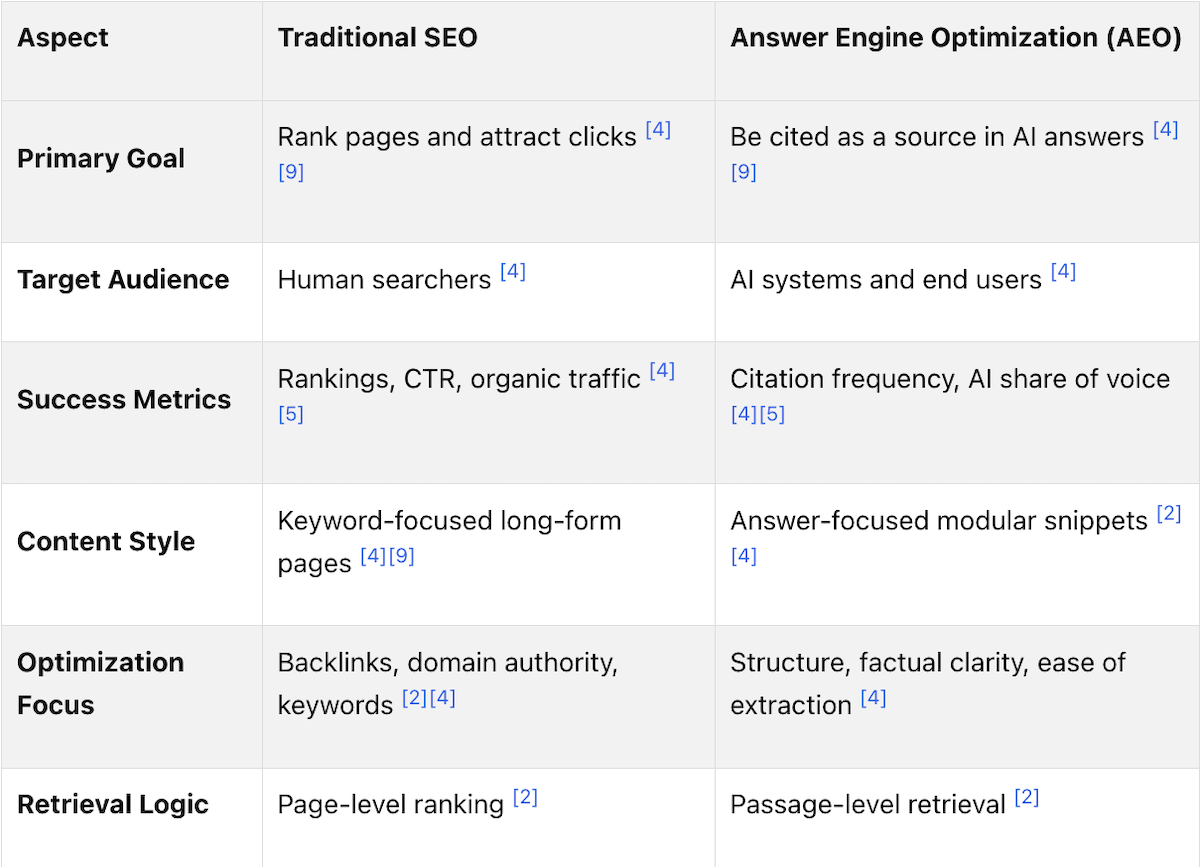
Traditional SEO targets human searchers and measures success through rankings, click-through rates, and organic traffic; AEO targets AI systems and measures success through citation frequency and AI share of voice — and notably, 59.6% of Google AI Overview citations come from URLs that don't rank in the top 20 organic search results.

What type of content structure gets cited most often by AI?

Modular content blocks — short paragraphs of 40–60 words, Q&A sections, bullet points, and concise definitions — are cited 28–40% more frequently than unstructured prose; structured content accounts for 66% of all featured snippets, and pages using FAQPage schema achieve a 41% citation rate compared to just 15% for pages without it.

What schema markup types matter most for AEO?

FAQPage, HowTo, Article, and Organization are the highest-priority schema types for AEO; pages with FAQPage schema achieve a 41% citation rate versus 15% without it, and detailed schema with rich attributes earns a 61.7% citation rate versus 41.6% for basic schema — with JSON-LD as the recommended implementation format.

Why does technical site readiness matter for AI citation?

AI crawlers like GPTBot, Claude-Web, and PerplexityBot must be explicitly allowed in robots.txt to access and index content; JavaScript-rendered pages that deliver an empty div to crawlers have nothing to index or cite, making server-side rendering essential for sites built on React, Angular, or Vue frameworks.
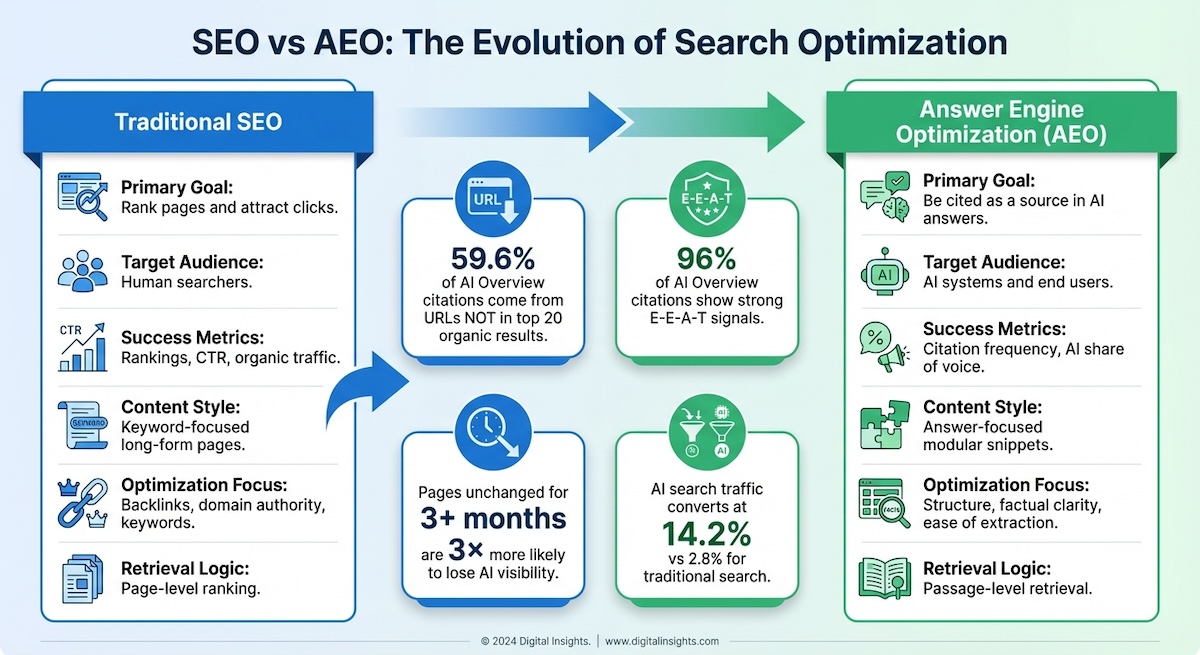
AI-driven search is reshaping content strategies. Here's the key takeaway: AEO (Answer Engine Optimization) is now more important than traditional SEO. Instead of focusing on clicks, AEO prioritizes mentions in AI-generated answers.

Why does this matter?

  • Google AI Overviews now appear in 25.11% of searches (up from 13.14% in 2025).
  • Pages with structured content are 2.8× more likely to be cited by AI.
  • Brands featured in AI Overviews see 35% more organic clicks and 91% more paid clicks.
  • AI search traffic converts at 14.2%, compared to 2.8% for traditional search.

Key Strategies for AEO Success

  • Structure content for AI: Use modular blocks, clear headings, and concise answers.
  • Focus on schema markup: Add FAQPage, HowTo, and Article schema to boost AI citations.
  • Technical readiness: Ensure AI crawlers can access your site, optimize Core Web Vitals, and use server-side rendering.

AEO is the future of search. If your content isn't optimized for AI, you're missing out on high-converting traffic.

Beyond SEO meets AEO: Optimizing content strategy for AI discoverability

AEO Fundamentals

SEO vs AEO: Key Differences and Optimization Strategies

What AEO Is and Why It Matters

Answer Engine Optimization (AEO) is all about crafting and organizing digital content so that AI-driven platforms - like ChatGPT, Google AI Overviews, Perplexity, and Gemini - can easily interpret and reference it as a direct response to user questions [4][5][10]. Unlike traditional SEO, which focuses on attracting clicks, AEO positions your content as the go-to source for AI-generated answers [2][4][5].

In an AI-first world, the focus shifts to what’s known as the "citation layer." Here, being referenced by AI carries more influence than simply ranking high in search results [4]. Why does this matter? AI search traffic boasts a conversion rate of 14.2% - nearly five times higher than Google’s 2.8% conversion rate. On top of that, brands mentioned in AI Overviews see 35% more organic clicks and 91% more paid clicks [5].

AEO also uses a technique called passage-level retrieval. Instead of analyzing an entire webpage, AI systems pull specific 200–400 word sections that answer questions directly. This approach ensures clarity for AI systems while also encouraging technical precision in content creation. Additionally, AEO emphasizes an entity-first strategy, focusing on the people, products, and organizations behind the content. This helps AI models establish topical authority and better understand the context of the information [2][9].

These unique elements highlight how AEO takes a different path compared to traditional SEO, as explored next.

How AEO Differs from SEO

The gap between SEO and AEO goes deeper than surface-level tactics. Traditional SEO is centered on human search behavior and relies on familiar ranking signals [4][9]. AEO, on the other hand, caters to both AI systems and human users by focusing on clear, structured, and easily extractable information [4]. Patrick Reinhart, VP of Services at Conductor, sums it up well:

"In traditional search, you're thinking of backlinks, you're thinking of content length, but with AEO, it's really all about creating very specific content and creating it at scale" [10].

While SEO success is measured by rankings, click-through rates, and overall organic traffic [4][5], AEO’s key metrics are citation frequency and AI share of voice - essentially, how often your brand is referenced in AI-generated answers [4][5]. Interestingly, 59.6% of citations in Google AI Overviews come from URLs that don’t even rank in the top 20 organic search results [5].

Another key takeaway: 96% of Google AI Overview citations come from sources that demonstrate strong Experience, Expertise, Authoritativeness, and Trustworthiness (E-E-A-T) signals. Additionally, pages left unchanged for more than three months are over three times more likely to lose visibility in AI-generated results [5]. AEO requires a fresh, precise, and modular approach to content that keeps pace with evolving AI systems.

Content Structuring Strategies for AEO

Building on these fundamentals, here are strategies to structure content effectively for AI extraction.

Using AI Search Intent to Organize Content

AEO success starts with aligning content to the primary search intent behind each query. For informational queries, focus on clear definitions and straightforward explanations. Evaluative searches benefit from comparisons and decision-making criteria, while transactional queries need detailed product specs and actionable steps. Mapping these queries to buyer personas and their journey stages - like awareness, consideration, or decision - can increase the chances of your content being cited.

Use natural language headings that mimic how users phrase questions when interacting with AI tools. For instance, instead of a generic heading like "AEO Best Practices Guide", try a question-based one, such as "How do you structure content for AEO?"

Consistency is key - stick to the same terminology throughout your content. For example, if you start with "content blocks", avoid switching to terms like "content modules." This consistency helps large language models map entities more accurately, establishing stronger topical authority. Once aligned with intent, break content into modular blocks to improve AI extraction efficiency.

Creating Modular Content Blocks for AI

Each section should function as a standalone unit that AI can easily extract without needing external context. This approach supports passage-level retrieval, where AI determines relevance by analyzing smaller content "chunks" rather than an entire page.

Adopt a modular structure by keeping paragraphs short - 2 to 4 sentences or about 40–60 words. Research shows that clearly structured formats, such as bullet points, Q&A sections, and concise definitions, are cited 28–40% more frequently [11]. In fact, structured content makes up 66% of all featured snippets [11].

Tailor your content blocks to specific goals. For example:

  • Use a "Definition + Micro-FAQ" block for platforms like Google AI Overview, keeping the word count between 45–75 words.
  • Action checklists should include 5–7 steps.
  • Stat nuggets should stay under 40 words.
  • Pros-and-cons tables work best with no more than six rows.

These constraints help AI tokenize and rank your content more effectively during extraction.

Answer-First Formatting Techniques

AI systems prioritize content that delivers answers quickly. If your key information is buried, it may be ignored. To counter this, place your main answer in the first one or two sentences after a heading, followed by supporting details.

As Aleyda Solis points out, AI evaluates content at the "chunk" level [1]. Unlike traditional SEO, which often delayed answers to boost engagement, AEO focuses on immediate retrieval to meet AI’s need for speed.

Once you’ve structured modular blocks, position your answers upfront to ensure AI captures your message. Use clear semantic cues to frame your context. For instance, try a "Job Story" approach: "When a [role] needs to [goal] without [constraint], the best solution is…". Use H2 headings for user questions and H3 headings for concise answers or initial steps. Bold key terms and definitions to make them stand out during extraction.

Lastly, using three or more schema types (such as FAQPage, HowTo, or Article) can boost citation rates by about 13% [1]. Pair answer-first formatting with structured data to simplify AI’s extraction process.

Technical Implementation for AEO

Once your content is structured for AI extraction, it's equally important to ensure your site's technical setup supports AI indexing. This setup creates a seamless connection between your structured content and AI systems, enabling better indexing and citations.

Schema Markup for AEO

JSON-LD stands out as the go-to format for schema markup. Unlike Microdata or RDFa, which embed structured data directly into HTML tags, JSON-LD keeps things tidy by placing structured data in a separate script block. This approach not only reduces clutter but also lowers computational demands for processing your site’s data [12][13][15].

To keep schema consistent across your site, embed it within your CMS templates. This strategy ensures uniform updates across all pages, especially those critical to revenue - like product pages, service descriptions, or comparison content aimed at high-intent users [15][17][18].

Focus on schema types that directly enhance AI-driven citations. Examples include:

  • FAQPage for answering conversational queries
  • HowTo for step-by-step guides
  • Organization to establish your brand's identity

A 2025 study highlighted the importance of schema: pages with FAQPage schema achieved a 41% citation rate, compared to just 15% for those without it. Additionally, detailed schema with rich attributes performed better, earning a 61.7% citation rate versus 41.6% for basic schema [14].

"Schema markup acts as a deterministic 'API' for LLMs, reducing hallucination rates by providing explicit key-value pairs." - Yue Zhu, Product Manager, Seenos.ai [12]

To further optimize, build an entity graph by linking schema types using @id for unique references and sameAs for external authoritative profiles like LinkedIn or Wikipedia [14][16]. For pages featuring multiple entities - such as articles with author bios and organizational details - use the @graph pattern in JSON-LD to map out these relationships clearly [14].

Make sure the data in your JSON-LD matches the visible content on your page. This "content-markup parity" ensures compliance with policies and builds trust with AI systems. Tools like Google’s Rich Results Test and the Schema.org Validator can help you validate your schema [12][14][16].

In a May 2025 test by Seenos.ai, pages using Product and FAQPage schema achieved an 85% rich snippet rate and 90% accurate citations, while pages without schema saw no rich snippets [12].

But schema is just one part of the equation. Technical performance and crawlability are also essential for effective AI indexing.

Core Web Vitals and Crawlability

For enterprise sites built on JavaScript frameworks like React, Angular, or Vue, server-side rendering (SSR) is a must. Many AI crawlers can’t process client-side JavaScript, which means pages relying solely on it may appear as empty <div id="root"></div> containers to these systems. Frameworks like Next.js or Nuxt.js solve this issue by delivering fully rendered HTML to crawlers from the start [3][15].

"If a crawler hits your page and sees an empty <div id="root"></div> instead of your content, it has nothing to index or cite." - Contentstack [3]

Optimizing Core Web Vitals and page load speeds is equally important. Faster, cleaner pages ensure that AI bots can efficiently parse your content without timing out. Sites with well-structured HTML and schema markup see AI citation rates 2.8 times higher than poorly structured sites [15]. Mobile responsiveness is another critical factor, as it directly influences how your content performs in voice search results [18].

To make your site accessible to AI crawlers, explicitly allow their user agents in your robots.txt file. Bots like GPTBot, Claude-Web, PerplexityBot, and Google-Extended need permissions to access your structured data [7][15]. In 2025, Mintlify implemented an llms.txt file and saw 436 AI crawler visits shortly after, proving the immediate impact of these discovery files [7].

Emerging standards like llms.txt (a short site summary), llms-full.txt (detailed documentation), and brand-facts.json (machine-readable identity) can further enhance your site's visibility to AI systems. These files act as a guide, helping AI understand your site’s structure more efficiently [7].

Finally, fix broken links, maintain consistent metadata, and ensure overall site integrity to build trust with AI systems. While structured data updates are typically recognized within 24 to 72 hours, full AEO implementation may take 30 to 90 days to deliver noticeable results [3][8].

AEO Audit and Optimization Process

This 90-day process ensures your site stays in sync with the evolving requirements of AI-driven search engines. It begins with technical infrastructure in the first month, transitions to content restructuring in the second, and concludes with authority building in the third [21]. The foundation lies in identifying technical gaps in your schema implementation and enhancing your content's entity framework.

Step 1: Audit Your Site for Schema Gaps

Start by confirming that AI crawlers can access your site. Check your robots.txt file to ensure agents like GPTBot, Claude-Web, and PerplexityBot are not blocked [7][22]. Use tools like Google's Rich Results Test and the Schema.org Validator to pinpoint missing or invalid schema markup on your pages [13][19][25]. You can also analyze competitor URLs with these tools to discover additional schema types, such as Speakable or ComparisonSchema, that could improve your content [21].

Focus on schema types critical for AEO, including Organization, FAQPage, Product, HowTo, and Article [13][19][7][20]. Check Google Search Console's Enhancements reports for schema errors, ensure all markup uses JSON-LD format, and verify that properties like sameAs, about, and mentions connect your entities to trusted sources [13][19][24].

Once you've addressed schema gaps, you can move on to building a robust entity framework.

Step 2: Map Your Entity Framework

Leverage NLP APIs to evaluate entity salience in your content, aiming for scores above 0.25 [7][21][22]. Highlight primary entities in your H1s and opening paragraphs, using their full names 8–15 times per article to improve recognition by NLP systems [7]. Pages featuring 15 or more recognized entities are 4.8 times more likely to appear in AI Overviews [5].

To enhance "Entity Confidence", ensure your brand is listed in major knowledge bases like Wikipedia, Wikidata, and Crunchbase [21]. With ChatGPT citing Wikipedia 47.9% of the time, these sources are crucial [21]. Use the sameAs property in your Organization schema to link to verified profiles on platforms like LinkedIn, Twitter, or Wikipedia [19][24]. Additionally, create AI discovery files: an llms.txt file (around 8KB) summarizing your site and a brand-facts.json file at the /.well-known/ URI to provide a machine-readable brand identity [7].

With your entity framework in place, the next step is to evaluate how well your content aligns with AI systems and performs in search.

Step 3: Track Performance and AI Alignment

Shift your focus from traditional ranking metrics to new ones like Citation Rate, AI Share of Voice, and Sentiment. Measure these across platforms such as ChatGPT, Perplexity, and Google AI Overviews [21][22]. AI-driven search traffic boasts a conversion rate of 14.2%, far outpacing the 2.8% seen in traditional Google search [5].

"In 2026, I'm no longer optimizing for position one - I'm optimizing for answer inclusion." - Maciej Turek, Consultant [22]

Track Prompt Coverage by monitoring how often your content appears in response to 20–50 buyer-intent prompts [22]. Test your content’s extractability by querying AI platforms directly with customer questions. Brands featured in AI Overviews see 35% more organic clicks and 91% more paid clicks than those that aren't [5].

Keep your content fresh - AI models prioritize updates made within the last three months, often ignoring outdated sites [7][5]. Also, assess your site's DOM complexity to ensure critical content is accessible in raw HTML. LLMs often struggle with JavaScript-rendered content or text hidden behind dynamic tabs [23]. Regular performance tracking not only validates your efforts but also ensures your AEO strategy remains effective over time.

Conclusion

The transition from traditional SEO to Answer Engine Optimization (AEO) marks a major shift in how enterprise content gains visibility. Today, structure takes precedence over sheer volume. Large language models (LLMs) and answer engines favor content that is well-organized, easy to extract, and backed by reliable information, rather than being stuffed with keywords [1]. Pages with clear structure and proper schema consistently outperform less organized ones when it comes to AI citation rates.

Consider this: click-through rates for the top search position plunged 49% - from 0.076 to 0.039 - between December 2024 and 2025, as AI answers began dominating search results [4]. Meanwhile, brands featured in Google AI Overviews see a 35% boost in organic clicks and a staggering 91% increase in paid clicks. Even better, AI-driven search traffic boasts a conversion rate of 14.2%, which is nearly five times higher than Google's 2.8% average [5].

"AEO content structure isn't about publishing more. It's about removing friction between your expertise and the systems deciding what gets reused." - Josh Spilker, Content Strategist, AirOps [1]

To stay competitive, enterprises need to adopt an answer-first approach by offering direct responses (40–60 words) right under headings. Ensuring technical accuracy with server-side rendering and thorough schema markup is equally important, as is maintaining consistent entity representation across all platforms [1][3][6][7]. Neglecting these steps could result in outdated content losing over 50% of its AI citation potential [4].

The data underscores the growing importance of AEO. Success in this new landscape means focusing on citations rather than clicks. Early adopters of AEO strategies enjoy an impressive 11.2% conversion rate from AI referrals [7], and 59.6% of AI Overview citations come from URLs that don’t even rank in the top 20 organic results [5].

For enterprises ready to adapt their content for the AI-driven future, Lite Studio offers the expertise and execution needed to stay ahead. With Lite Studio, you can effectively implement AEO strategies and ensure your content thrives in this evolving digital landscape.

FAQs

How do I measure AEO success?

To gauge the success of your AEO efforts, keep an eye on key metrics such as AI Share of Voice, citation rate, sentiment analysis, and entity correctness. These indicators reveal how frequently and accurately AI platforms reference your content. To improve your content’s chances of being used by AI tools, prioritize answer-first copy, implement schema markup, and ensure proper validation. Additionally, review and refresh your content every 30 days to boost visibility and maintain credibility in AI-powered search environments.

What content format gets cited most by AI?

AI systems tend to rely on structured content because it’s easier to process and verify. Formats such as clear headings, question-and-answer sections, lists, tables, and evidence blocks are particularly effective. These structures help AI systems interpret the information more accurately and make it easier to cite.

What tech changes do I need for AEO?

To make your content stand out in AI-driven search results, focus on creating content that's easy for both users and machines to understand. Here's how:

  • Structure matters: Use clear headings, concise paragraphs, and scannable sections to make your content more readable.
  • Leverage schema markup: Formats like FAQ or HowTo schema help AI grasp the context and purpose of your content more effectively.
  • Technical performance: Ensure your site loads quickly, is mobile-friendly, and has clean, efficient code. These factors help AI crawl and interpret your site more easily.

By following these steps, you can boost your content’s visibility and credibility in AI-powered search environments.

Key Points

What is AEO and how does it differ fundamentally from traditional SEO?

  • AEO shifts the goal from click attraction to answer inclusion — rather than optimizing for a high position in a results list that a human scans, AEO positions content to be extracted and cited directly by AI systems as the response to a user's question, bypassing the click layer entirely
  • The citation layer has become more valuable than page one rankings — click-through rates for the top organic search position dropped 49% between December 2024 and 2025 as AI answers began dominating search results; meanwhile brands cited in AI Overviews see 35% more organic clicks and 91% more paid clicks than those that are not
  • AEO uses passage-level retrieval rather than page-level ranking — AI systems pull specific 200–400 word sections that answer questions directly rather than evaluating the entire page, which means a single well-structured section of an otherwise average page can earn citation even if the overall page doesn't rank highly
  • 59.6% of AI Overview citations come from URLs outside the top 20 organic results — this is the most important structural difference between SEO and AEO; domain authority and backlink profiles that drive traditional rankings are far less determinative of AI citation than content structure, factual clarity, and schema implementation
  • AEO success is measured by citation frequency and AI share of voice — tracking how often your brand is referenced across ChatGPT, Perplexity, and Google AI Overviews across 20–50 buyer-intent prompts replaces the rankings dashboard as the primary performance indicator for content that targets AI-first search behavior

How should content be structured to maximize AI citation frequency?

  • Each content section should function as a standalone extractable unit — modular blocks of 40–60 words allow AI systems to tokenize and rank individual sections during passage-level retrieval without requiring surrounding context, which is why this format consistently outperforms long-form narrative prose in AI citation studies
  • Answer-first formatting is the single most impactful structural change — placing the direct answer in the first one or two sentences after a heading before supporting details ensures AI captures the key information even when extraction is limited to the top of a section; burying answers after context or qualifications causes them to be missed
  • Q&A sections, bullet points, and concise definitions are cited 28–40% more frequently than unstructured prose — structured formats provide the semantic clarity that AI systems use to determine whether a passage is a reliable answer to a specific query; structured content accounts for 66% of all featured snippets
  • Consistent terminology throughout an article improves AI entity mapping — switching between synonyms (e.g., "content blocks" and "content modules") forces large language models to reconcile whether they refer to the same concept, reducing topical authority signals; consistent terminology throughout an article makes entity recognition more reliable
  • Natural language question-based headings align with how AI systems match queries to content — headings framed as questions (e.g., "How do you structure content for AEO?") match the conversational query patterns that AI search users generate, creating a direct signal that the section answers that specific question type

What schema markup implementation produces the highest AEO citation rates?

  • FAQPage schema is the highest-leverage single schema type for AEO — pages with FAQPage schema achieve a 41% citation rate compared to 15% for pages without it, and pairing FAQPage with additional schema types like HowTo or Article increases citation rates further; using three or more schema types boosts citation rates by approximately 13%
  • Detailed schema with rich attributes significantly outperforms basic schema — a 61.7% citation rate for rich attribute schema versus 41.6% for basic schema demonstrates that the completeness and specificity of implementation matters as much as the schema type selection itself
  • JSON-LD is the recommended implementation format — unlike Microdata or RDFa which embed structured data directly in HTML, JSON-LD places it in a separate script block that reduces processing complexity for AI systems and makes site-wide schema management through CMS templates more reliable and maintainable
  • Building an entity graph using @id and sameAs properties extends schema authority — linking schema types to verified external profiles on LinkedIn, Wikipedia, and Wikidata using the sameAs property helps AI models establish brand identity with confidence; ChatGPT cites Wikipedia 47.9% of the time, making knowledge base presence a meaningful authority signal
  • Content-markup parity is required for AI trust — the data in JSON-LD must match the visible content on the page; mismatches between structured data claims and actual page content reduce AI confidence in the source and can trigger citation avoidance for the entire domain, not just the individual page

What technical site requirements are necessary for AI crawlers to index and cite content?

  • AI crawlers must be explicitly permitted in robots.txt — GPTBot, Claude-Web, PerplexityBot, and Google-Extended all require specific permission entries; sites that block these agents by default or through overly broad disallow rules are invisible to the AI systems they are trying to earn citations from regardless of content quality or schema implementation
  • Server-side rendering is essential for JavaScript-heavy sites — AI crawlers that encounter a page delivering an empty <div id="root"></div> instead of rendered HTML have nothing to index or cite; Next.js and Nuxt.js frameworks solve this by delivering fully rendered HTML from the first response, making the site's content immediately accessible to AI indexing
  • Core Web Vitals and page load speed affect AI indexing efficiency — faster, cleaner pages allow AI bots to parse content without timing out, and sites with well-structured HTML and schema markup see AI citation rates 2.8 times higher than poorly structured sites; mobile responsiveness also directly influences voice search performance
  • Emerging discovery files like llms.txt and brand-facts.json accelerate AI visibility — an llms.txt file summarizing site structure and a brand-facts.json file at the /.well-known/ URI provide AI systems with machine-readable site identity; Mintlify implemented an llms.txt file and recorded 436 AI crawler visits shortly after, demonstrating the immediate discoverability impact of these files
  • Broken links, inconsistent metadata, and DOM complexity all reduce AI citation confidence — content hidden behind dynamic tabs or loaded via client-side JavaScript after initial render is frequently inaccessible to AI crawlers; maintaining clean site integrity and inspectable raw HTML for all critical content is a baseline technical requirement for sustained AI citation performance

What does a 90-day AEO audit and implementation process look like?

  • Month one focuses on technical infrastructure and schema gap remediation — confirming AI crawler access in robots.txt, running schema validation against Google's Rich Results Test and the Schema.org Validator, identifying missing FAQPage, HowTo, Article, and Organization markup, and auditing Google Search Console Enhancements reports for schema errors form the foundation before content restructuring begins
  • Entity framework mapping is a month one priority alongside schema work — using NLP APIs to evaluate entity salience, ensuring primary entities appear in H1s and opening paragraphs, and aiming for 15 or more recognized entities per article (pages with 15+ entities are 4.8 times more likely to appear in AI Overviews) establishes the topical authority signals that AI citation depends on
  • Month two restructures existing content into modular, answer-first formats — converting long-form narrative content into 40–60 word modular blocks, adding Q&A sections and definition blocks, implementing answer-first heading structures, and applying consistent terminology throughout each article converts existing content into AI-extractable assets without requiring new content creation
  • Month three builds entity confidence through external authority signals — ensuring brand presence in Wikipedia, Wikidata, and Crunchbase, linking Organization schema to verified external profiles, creating llms.txt and brand-facts.json discovery files, and monitoring prompt coverage across 20–50 buyer-intent queries on ChatGPT, Perplexity, and Google AI Overviews closes the authority gap that schema and structure alone cannot address
  • Performance tracking shifts entirely to AI-native metrics — citation rate, AI share of voice, and sentiment across AI platforms replace traditional rankings dashboards; content freshness must be maintained consistently because pages unchanged for more than three months are over three times more likely to lose AI visibility, making AEO an ongoing content operations discipline rather than a one-time optimization project

Why is AEO now a business-critical priority rather than an optional content enhancement?

  • AI Overviews now appear in 25.11% of searches, up from 13.14% in 2025 — the portion of search results pages where AI-generated answers appear rather than organic blue links is growing rapidly, meaning the addressable audience for traditional SEO results is contracting at the same rate that AI citation coverage is expanding
  • AI search traffic converts at 14.2% versus 2.8% for traditional search — the commercial value of AI citation is not just about visibility; users arriving via AI-generated answers are demonstrably higher-intent and convert at nearly five times the rate of users arriving through standard organic results, making citation share a direct revenue variable
  • Early AEO adopters are seeing an 11.2% conversion rate from AI referrals — brands that have implemented structured content and schema at scale are already capturing this high-converting traffic channel while competitors who have not yet adapted continue optimizing for click-based metrics in a declining organic click environment
  • Pages unchanged for more than three months lose over 50% of AI citation potential — AEO is not a publish-and-forget content strategy; AI models prioritize recently updated content, and the freshness decay curve is steep enough that content operations must treat regular structured updates as a maintenance requirement comparable to technical site health monitoring
  • The optimization target has fundamentally shifted from position one to answer inclusion — as one AEO consultant summarized the transition, the question is no longer which page ranks highest but whether a brand's expertise is the source AI systems choose to reuse when answering questions in their category; brands that treat this shift as optional are ceding answer authority to competitors who are already adapting

Get Started

Streamline your online presence and captivate users with a refined, single or minimal page experience. Schedule a call with our team today to discuss how we can simplify your site and elevate your brand in just 30 days.

Schedule Call