Lite Studio Webclip

Simplify Your Website. Elevate Your Brand.

Schedule a call with our expert web design and answer engine optimization team today to discuss how we can improve search visibility and upscale your brand's online presence in just 30 days.

Schedule Call

How to Find Keywords for Answer Engines

Matt Clark Lite Studio Headshot
Matt Clark
March 6, 2026
AI-driven search is changing keyword research. Lite Studio helps you find and organize conversational, question-based keywords for answer engines like ChatGPT and voice assistants. Optimize for long-tail queries, intent clusters, and schema markup to boost visibility and conversions in 2026.

Article Summary

How is keyword research different for answer engines compared to traditional SEO?

Answer engine optimization focuses on conversational, question-based keywords that match how people interact with AI and voice assistants. Queries are longer, intent-driven, and require content structured for direct, concise answers.

What tools are best for finding keywords for answer engines?

Tools like AnswerThePublic, AlsoAsked, Google Autocomplete, and Semrush’s Questions filter help uncover real user questions and conversational phrases. AI platforms like ChatGPT can also generate clusters of related queries.

Why are long-tail and zero search volume keywords important for AEO?

Over 70% of keywords searched are long-tail, and many have zero reported search volume. These highly specific queries often capture strong intent and can drive higher conversion rates than broad keywords.

How should content be structured for answer engine optimization?

Content should use question-based headings, concise 40–60 word answers, and modular sections. Adding FAQ schema and organizing keywords into clusters helps AI extract and cite your content more effectively.

What metrics matter most for tracking AEO keyword performance?

Share of Answers, citation frequency in AI responses, and traffic from AI platforms are key metrics. Tracking these helps measure visibility and optimize for answer engine discoverability.

AI-driven search is reshaping how people find information. Unlike traditional SEO, Answer Engine Optimization (AEO) focuses on creating content tailored for AI systems like chatbots, voice assistants, and generative search engines. Here's what you need to know:

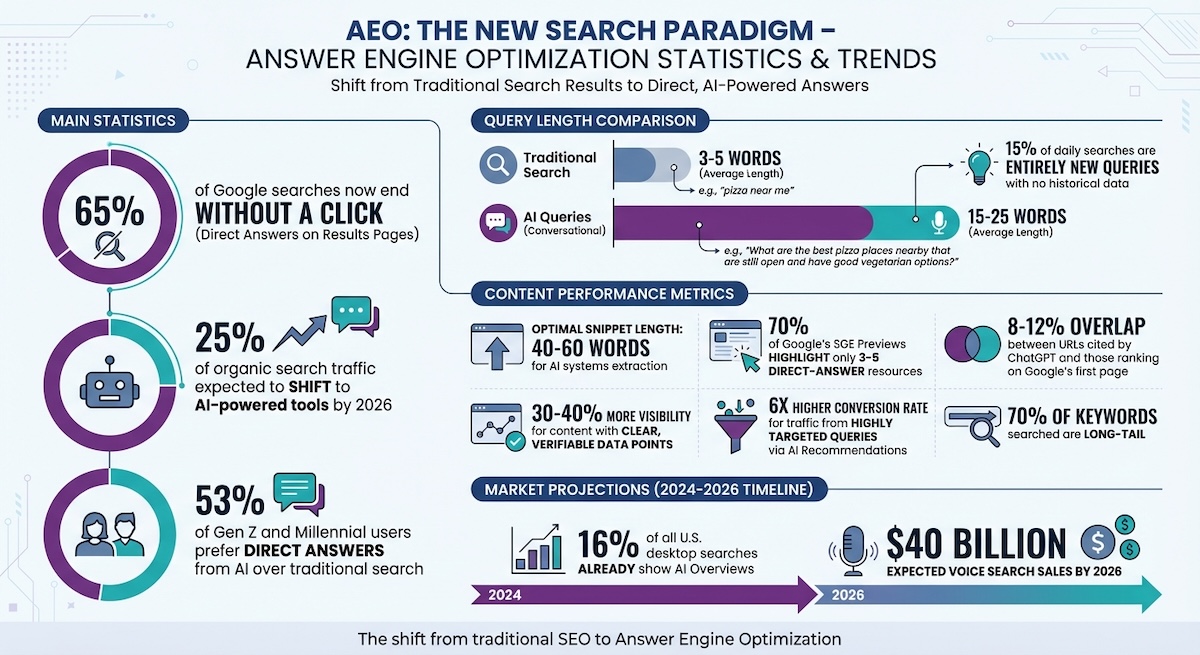
  • 65% of Google searches now end without a click, as users get answers directly on results pages.
  • By 2026, 25% of organic search traffic is expected to shift to AI-powered tools like chatbots.
  • AI queries are longer and conversational, often 15–25 words, compared to traditional 3–5 word searches.

To succeed, you need to focus on question-based, intent-driven keywords that match how people interact with AI. Use tools like Google Autocomplete, AnswerThePublic, and Semrush’s "Questions" filter to find conversational phrases. Organize these keywords into clusters, structure your content with clear, question-based headings, and ensure it’s easy for AI to extract concise, accurate answers.

Key takeaway: Optimize for how people ask questions, not just traditional keywords. This strategy positions your content as the go-to resource for AI systems.

Answer Engine Optimization Statistics and Key Metrics 2024-2026

How to Do Keyword Research for AI & Google (2026)

How Answer Engines Process Queries

Understanding how answer engines process queries is essential for crafting content that aligns with AEO (Answer Engine Optimization) requirements. These engines have evolved beyond simple keyword matching; they now focus on deciphering the intent behind a query. When you type or speak a question, advanced AI systems break it down into smaller subqueries, often called "grounding searches", to analyze its individual components. For example, a query like "Compare CRMs for a 5-person team under $300/month" prompts the system to separately evaluate factors like pricing, team size, and features. Afterward, it combines these insights into a single, cohesive response. Instead of ranking entire web pages, modern systems extract concise answer snippets - typically 40 to 60 words long - to provide a direct response [6][2].

To ensure accuracy, these systems cross-check multiple sources to gauge confidence levels [3]. Interestingly, about 15% of daily searches involve new conversational queries that the system hasn't encountered before [2]. This advanced query processing lays the groundwork for identifying the different types of queries that answer engines address.

Main Query Types for Answer Engines

Answer engines now categorize queries into distinct types, moving beyond traditional informational or transactional searches. Here’s a breakdown:

  • Comparative queries: These trigger side-by-side evaluations, comparing specifications or features of different options.
  • Exploratory queries: These invite broader discovery, gathering a variety of perspectives or insights.
  • Clarifying queries: These involve follow-up questions, such as "Are you traveling solo or with a group?" to refine the search results.
  • Ambient queries: These are proactive, delivering updates based on user behavior - like automatically showing weather updates if you frequently check conditions before a run [6].
"People ask AI tools completely different questions than they search on Google. Think conversational, like 'What's the best coffee shop near me' instead of 'coffee shop downtown.'" - r/SEO [1]

When doing keyword research, it’s helpful to align each query type with a suitable content format. For example:

  • Use structured tables or feature comparisons for comparative queries.
  • Provide in-depth guides for exploratory queries.
  • Create detailed FAQ sections to address clarifying queries.

This approach allows you to target clusters of 100–300 related questions rather than focusing on just 10–20 isolated keywords [1]. Shifting from generic keywords to specific, question-based phrases is key to meeting user expectations.

Focus on Questions, Not Just Keywords

Traditional keyword research often revolves around search volume and competition. However, AEO takes it a step further by validating intent and analyzing the natural phrasing users prefer. For example, by reviewing sales call transcripts, support tickets, or community forums, you might find that people aren’t searching for generic terms like "CRM features." Instead, they’re asking specific questions like, "How do I migrate 10,000 contacts from Salesforce to HubSpot without losing custom fields?"

Transform your keyword list into a question bank. Instead of focusing on broad terms like "project management tools", create content around detailed, conversational queries like:

  • "What’s the best project management tool for remote teams with async workflows?"
  • "How do I set up automated task assignments in Asana?"

These longer, natural-language queries - typically 15 to 25 words - better reflect how users interact with AI systems and voice assistants [1].

Structure your content with headings that mirror real questions. Replace vague section titles like "Product Specifications" with specific ones, such as "Is this espresso machine compatible with Nespresso pods?" Remember, 70% of Google's Search Generative Experience previews highlight only three to five direct-answer resources. Your goal is to be among those few by thoroughly addressing the full range of user questions [7].

Tools and Methods for Finding Keywords

Finding the right keywords for answer engines means focusing on conversational queries and uncovering the specific questions people ask AI platforms. A good starting point is using People Also Ask (PAA) extraction tools like AlsoAsked ($15–$49/month) and Ranktracker, which pull questions directly from Google's PAA boxes. These tools create "question trees" that show how a single query branches into many related questions - exactly the kind of conversational structure AI models like Gemini and Perplexity rely on to generate responses [8][11].

For real-time insights into search intent, tools like AnswerThePublic (offering a free tier with three searches per day) and Google Autocomplete are invaluable. They gather the "who, what, why, and how" phrases users type into search bars [9][12]. Meanwhile, traditional SEO tools like Semrush’s Keyword Magic Tool, Moz Keyword Explorer, and Ranktracker have adapted by adding "Questions" filters. These filters help isolate long-tail, interrogative queries that align with how users interact with answer engines. For example, Semrush’s free account allows users to collect up to 100 keyword ideas daily [12].

AI tools like ChatGPT, Claude, or Perplexity can also be prompted with seed topics to generate clusters of related queries. As former Google data scientist Seth Stephens-Davidowitz remarked:

"Google searches are the most important dataset ever collected on the human psyche" [9][13].

AI platforms are now extending this dataset into deeper, more nuanced conversations. By combining traditional SEO insights with these newer tools, you can better understand the phrasing AI platforms prioritize.

Use Keyword Research Tools

The best keyword research tools for Answer Engine Optimization (AEO) focus on extracting questions rather than just measuring search volume. For instance, AlsoAsked visualizes how questions branch from a single topic, helping you see how user curiosity evolves naturally. Similarly, AnswerThePublic organizes questions into visual maps based on their type (how, what, why, when, where), making it easy to identify patterns in user intent [1][9][12].

Traditional tools like Semrush and Ranktracker still play a role when used strategically. By applying the "Questions" filter to your keyword lists, you can quickly pinpoint interrogative queries. Look for those averaging 15–25 words - these longer, conversational-style questions mirror how people interact with AI assistants [1]. For quick keyword insights while browsing, the Keywords Everywhere browser extension (priced at $10) displays PAA and related searches directly on your screen [1].

Over 70% of keywords searched are long-tail, and many of these report zero search volume in traditional tools [11]. But don’t dismiss them - these "Zero Search Volume" (ZSV) keywords often capture highly specific intent and can lead to better conversion rates. Platforms like Reddit and Quora are great for discovering emerging questions that haven’t yet been indexed in keyword databases [1][12]. After gathering external data, analyze your site’s internal data to uncover additional high-intent questions.

Review Your Own Search Data

Your internal search data is a goldmine for refining AEO strategies. Google Search Console (GSC), for example, can highlight queries where your site gets high impressions but low clicks. These gaps often signal the need for "answer-first" content that directly addresses user intent. Use regex filters in GSC to find queries ranking on Page 2 (positions 11–30) without a dedicated landing page. These "striking distance" keywords show where search engines already see your site as relevant [14].

Filtering GSC data by "Mobile" can reveal voice-search-friendly phrases and "how do I..." questions that are particularly relevant for answer engines. Interestingly, about 15% of daily searches are entirely new queries with no historical data [14]. Your GSC data can help you spot these trends before they appear in traditional keyword tools.

Lastly, don’t overlook customer conversations. Analyze sales call transcripts (with tools like Gong or Chorus.ai), support tickets, and live chat logs to identify high-intent questions in your customers’ own words. These insights often reveal "bottom-of-funnel" queries that capture specific user needs. Traffic from these highly targeted queries can deliver a 6x higher conversion rate compared to traditional search visitors, as users are pre-qualified by the AI's recommendations [1].

Test Keywords with Answer Engines

Once you’ve gathered potential keywords, the next step is to refine and validate them using real-time AI insights. Testing your keywords in answer engines helps confirm whether they align with user intent and how AI platforms interpret and respond to those queries.

Use Autocomplete and AI Tools

Autocomplete features are an effective way to verify real user demand. As Benjamin Rojas, President of AIOSEO, puts it:

"Google autocomplete won't display the query if it didn't get traffic. These keywords are more than worth targeting!" [15]

This makes autocomplete a reliable method for identifying search terms that might not even show up in traditional keyword tools.

To dig deeper, try the Alphabet Soup Method. Start with your seed keyword and add each letter of the alphabet (e.g., "answer engine optimization a", "... b"). You can also add modifiers like "best" or "how to" to uncover long-tail and conversational queries [15].

Another trick? Experiment with cursor placement. For instance, moving your cursor to the start of a query or between words can trigger different autocomplete suggestions compared to leaving it at the end. For question-based queries, type your core keyword, then move the cursor to the beginning and add words like "how" or "why" to explore popular question formats [10][15].

To test your keywords across multiple AI platforms, tools like ChatHub can help you assess visibility in systems like Gemini, ChatGPT, and Perplexity [16]. Additionally, free tools such as LowFruits and Keyword Shitter2 can automate autocomplete research, while paid tools like KeywordTool.io (starting at $69/month) combine this data with search volume insights [15].

Once you’ve validated your keywords, the next step is understanding the types of content formats AI engines prefer for those terms.

Check Content Sources and Formats

AI platforms often favor specific content formats when responding to queries. Testing your keywords in tools like ChatGPT or Perplexity can reveal whether the AI prefers FAQs, comparison tables, step-by-step guides, or even video transcripts. This insight helps you structure your content to match what the AI deems most suitable.

The distinction between Owned AEO and Earned AEO becomes crucial here. For technical, niche queries like "how to integrate [specific tool]", AI engines tend to cite brand-owned resources such as help centers or product guides. On the other hand, broader queries like "best project management software" often pull from third-party reviews on platforms like Reddit, G2, or Wikipedia [1][7]. Notably, 53% of Gen Z and Millennial users now prefer getting direct answers from AI rather than browsing traditional search results [7].

Content that includes clear, verifiable data points tends to perform better, with approximately 30–40% more visibility in AI-generated answers compared to content that's purely qualitative [16]. For instance, if the AI frequently cites FAQ-style content for your keyword, consider structuring your page as a series of direct question-and-answer pairs. If it favors comparison tables, create detailed side-by-side feature breakdowns.

Don’t forget to check the "Ask a follow-up" sections in AI-generated snapshots. These can highlight whether your keyword is associated with negative sentiment or outdated information, signaling areas where your content may need updates [10][16]. It’s worth noting that there’s only an 8–12% overlap between URLs cited by ChatGPT and those ranking on Google’s first page, meaning high organic rankings don’t guarantee visibility in AI-driven answers [1].

Organize and Optimize Keywords for Content

Once you've identified your tested keywords, the next step is organizing and optimizing them for Answer Engine Optimization (AEO). Instead of focusing on individual keywords, group them into AI-friendly question clusters. This means creating a single landing page that addresses 100–300 related queries within a specific topic. This method aligns with how AI platforms conduct grounding searches - essentially, the internal queries they use to pull information from your content [1].

Build a Keyword Tracking System

To maximize conversions, group your keywords by intent, prioritizing Bottom-of-Funnel (BOFU) queries. These include searches like feature comparisons or implementation guides, which tend to convert at much higher rates compared to broader, informational queries [1]. Visitors referred by large language models (LLMs) are often pre-qualified, as they’ve already received detailed AI responses before landing on your site, making them more likely to convert [1].

Expand your tracking beyond traditional rankings. Focus on metrics like "Share of Answers" - how often your brand appears in AI-generated responses - and citation frequency to measure your visibility in AI platforms [1]. To ensure AI models recognize your brand and key terms, create an Entity Sheet. This sheet should list your canonical brand names, products, and essential concepts, linking them to verified sources like Wikipedia or Wikidata URIs [17].

When organizing keywords, use the pillar-cluster model. Start with a comprehensive "Pillar Page" that acts as a central guide to your topic, and link it to multiple "Cluster Pages" that cover specific subtopics. For instance, a pillar page on "Answer Engine Optimization" could link to cluster pages on topics like "AEO vs. SEO", "Schema Markup for AEO", and "Voice Search Optimization" [16].

Once your keywords are organized, the next step is structuring your content for seamless AI extraction.

Optimize Content for Answer Engines

Design your content with question-based headings (H2/H3) that reflect natural language queries, such as "How do I create a cluster strategy?" Following each heading, include a concise 40–60 word summary that directly answers the question before diving into further details [16]. As B2B SaaS Copywriter Tanatswa Chingwe explains:

"AI models have learned that conciseness signals usefulness, and the brands that write this way are the ones being rewarded." [7]

Break your content into modular sections of 75–300 words, with each section focused on answering a single question. This makes it easier for AI systems to extract specific chunks of information. Additionally, front-load your content with verifiable data, as data-rich content tends to gain 30–40% more visibility in AI-generated answers [16].

Incorporate technical schema markup using JSON-LD to guide AI crawlers. Depending on your content type, use schemas like FAQPage, HowTo, or Product to structure your information [16].

To ensure AI crawlers can easily parse your content, reduce DOM complexity. Keep critical answers in raw HTML and avoid hiding them behind JavaScript elements, which some crawlers may struggle to process [4]. For enterprise-level websites with complex structures, Lite Studio offers services to streamline your architecture, making it more AI-friendly while improving both search visibility and user experience.

Conclusion

Finding keywords for answer engines requires understanding how people naturally ask questions during AI-driven conversations. As Mayank Mishra, Founder of Consumable AI, explains:

"SEO gets your book on the library shelf; AEO gets your book chosen and recommended by the discerning AI librarian as the ultimate authority" [18].

This evolution from short keyword phrases to conversational queries demands a shift in research - one that mirrors how people speak, rather than how they type into a search bar.

Consider this: 53% of Gen Z and Millennial users now prefer direct answers from AI over traditional search results [7]. With AI Overviews already appearing in 16% of all U.S. desktop searches [5] and voice search sales expected to hit $40 billion by 2026 [19], brands that prioritize question clusters and concise, answer-first content will lead the charge in the new search landscape.

Effective keyword research today means focusing on intent rather than sheer volume. Roughly 15% of daily searches are entirely new, with no prior data available [14]. By analyzing customer interactions - like sales calls, support tickets, and online forums - you can uncover the exact questions your audience is asking. Then, by structuring content with clear headings, precise answers, and proper schema markup, you’re not just optimizing for algorithms - you’re making your expertise more quotable and accessible.

This approach doesn’t just enhance visibility; it drives conversions. Building topical authority through well-structured, user-focused content positions your brand as the go-to resource for AI engines. And when your messaging remains consistent across all platforms, you solidify your reputation as the trusted source that AI tools recommend first.

Start by addressing the questions your audience is already asking. Organize these into intent-driven clusters and craft answers that AI can easily extract. In a world where AI previews feature only a select few direct responses [7], this strategy ensures your content stands out.

For a deeper dive into optimizing your content for AI-driven search, explore the comprehensive AEO strategies available at Lite Studio.

Key Points

What are the main differences between AEO and traditional SEO keyword research?

  • Conversational queries: AEO targets natural, question-based phrases (15–25 words)
  • Intent-driven clusters: Focus on user intent, not just search volume
  • Direct answers: Content must provide concise, extractable responses
  • AI platform alignment: Optimize for how AI and voice assistants process queries

Which tools and methods are most effective for AEO keyword discovery?

  • AnswerThePublic and AlsoAsked: Visualize question trees and conversational patterns
  • Google Autocomplete: Reveals real-time, high-intent queries
  • Semrush Questions filter: Isolates interrogative, long-tail keywords
  • AI tools (ChatGPT, Perplexity): Generate and validate keyword clusters

Why are zero search volume (ZSV) keywords valuable for answer engines?

  • High specificity: Capture unique, intent-rich queries
  • Better conversions: ZSV keywords often lead to higher conversion rates
  • Emerging trends: Identify new questions before they appear in traditional tools
  • Competitive advantage: Less competition for highly targeted queries

How should keywords be organized for maximum AEO impact?

  • Intent clusters: Group related questions by user intent (BOFU, MOFU, TOFU)
  • Pillar-cluster model: Central pillar pages link to supporting cluster pages
  • Entity sheets: Map brand, product, and concept names to verified sources
  • FAQ and HowTo schema: Structure content for easy AI extraction

What are the best practices for optimizing content for answer engines?

  • Question-based headings: Use natural language queries as H2/H3s
  • Concise answers: Provide 40–60 word summaries below each heading
  • Modular sections: Break content into focused, scannable blocks
  • Schema markup: Implement FAQPage, HowTo, and Product schema for machine readability
  • Reduce DOM complexity: Keep answers in raw HTML for AI crawlers

How does Lite Studio help businesses succeed with AEO keyword strategies?

  • AEO audits: Identify high-impact, conversational keyword opportunities
  • Content restructuring: Organize pages for modular, answer-first extraction
  • Schema implementation: Add structured data for enhanced AI visibility
  • Performance tracking: Monitor Share of Answers and AI citation rates
  • Continuous optimization: Refresh content and keyword clusters for ongoing results

Get Started

Streamline your online presence and captivate users with a refined, single or minimal page experience. Schedule a call with our team today to discuss how we can simplify your site and elevate your brand in just 30 days.

Schedule Call